
A planned plant shutdown gives your maintenance team access to equipment that may be difficult or impossible to service during normal production. It also creates a narrow window where missing parts, unavailable labor, overlooked safety requirements, and unexpected work can quickly turn into costly delays.
A plant shutdown checklist helps you verify that the people, work, materials, procedures, and equipment are ready before the shutdown begins. During execution, it can also help you control scope changes, track progress, prepare equipment for restart, and ensure important closeout tasks are not forgotten.
Use the checklists below as a practical reference for your next maintenance shutdown. You can also download our editable maintenance shutdown planning checklist and customize it for your facility.
Download our editable maintenance shutdown planning checklist
A plant shutdown checklist is a structured list used by maintenance, operations, safety, and plant leadership to verify that critical shutdown activities have been addressed.
Instead of relying on memory or scattered spreadsheets, you can assign each requirement an owner, due date, and status and quickly identify anything that could prevent the shutdown or restart from moving forward.
You can add, remove, and modify checklist items based on your equipment, shutdown scope, internal procedures, and regulatory requirements.
What is included in this plant shutdown checklist template?
The downloadable plant shutdown checklist template is organized into four tabs:
| Template tab | What it covers |
|---|---|
| Shutdown overview | Shutdown dates, scope, affected areas, objectives, owners, key milestones |
| Master shutdown checklist | Pre-shutdown, execution, restart, and closeout tasks |
| Restart readiness | Verification before equipment or production is returned to service |
| Lessons learned | Problems, causes, impacts, corrective actions, and future recommendations |
The master checklist also gives you fields for the phase, category, checklist item, owner, due date, status, shutdown/restart gate, evidence, notes, and approval.
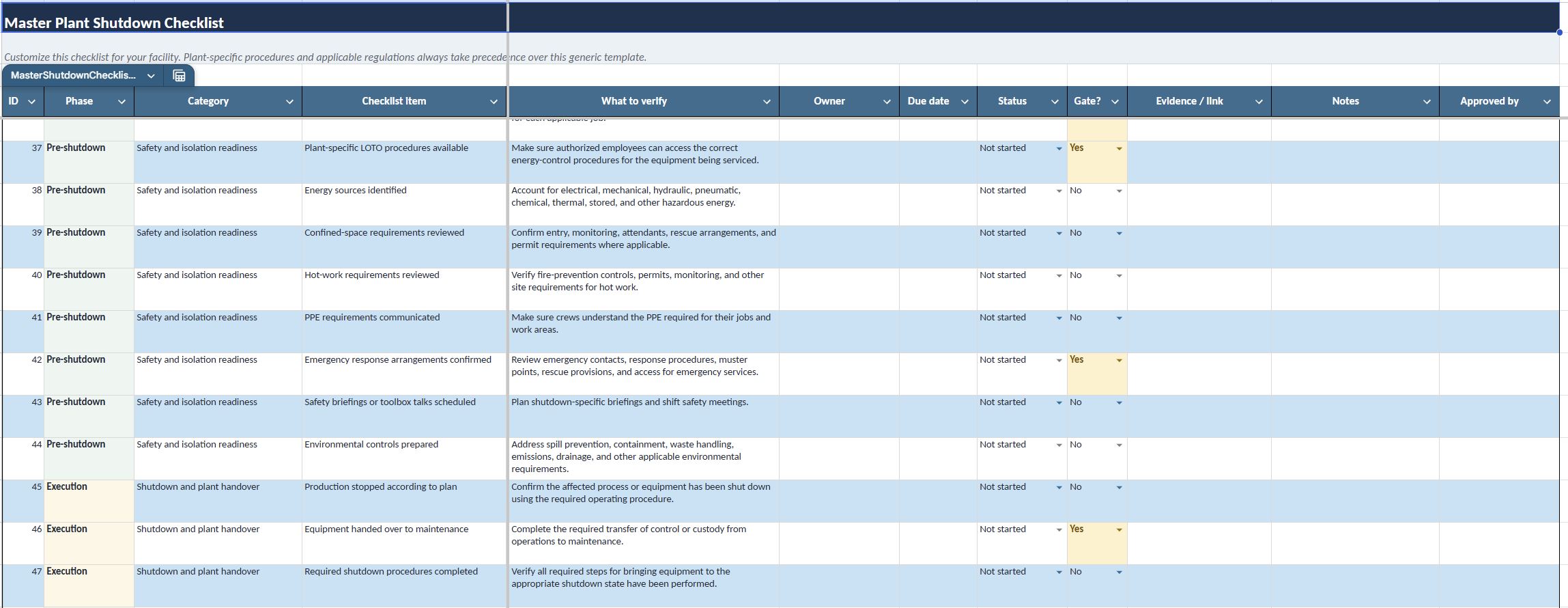
This makes the template useful as more than a printable checklist. You can filter it to see outstanding tasks, blocked items, critical gates, or everything assigned to a specific person.
1. Pre-shutdown maintenance planning checklist
The goal before the shutdown is to make sure the work is actually ready to execute before production stops and the clock starts ticking.
This checklist focuses on readiness verification. For a deeper look at scope development, work packages, critical-path scheduling, resource planning, and other STO practices, see our turnaround planning and scheduling guide.
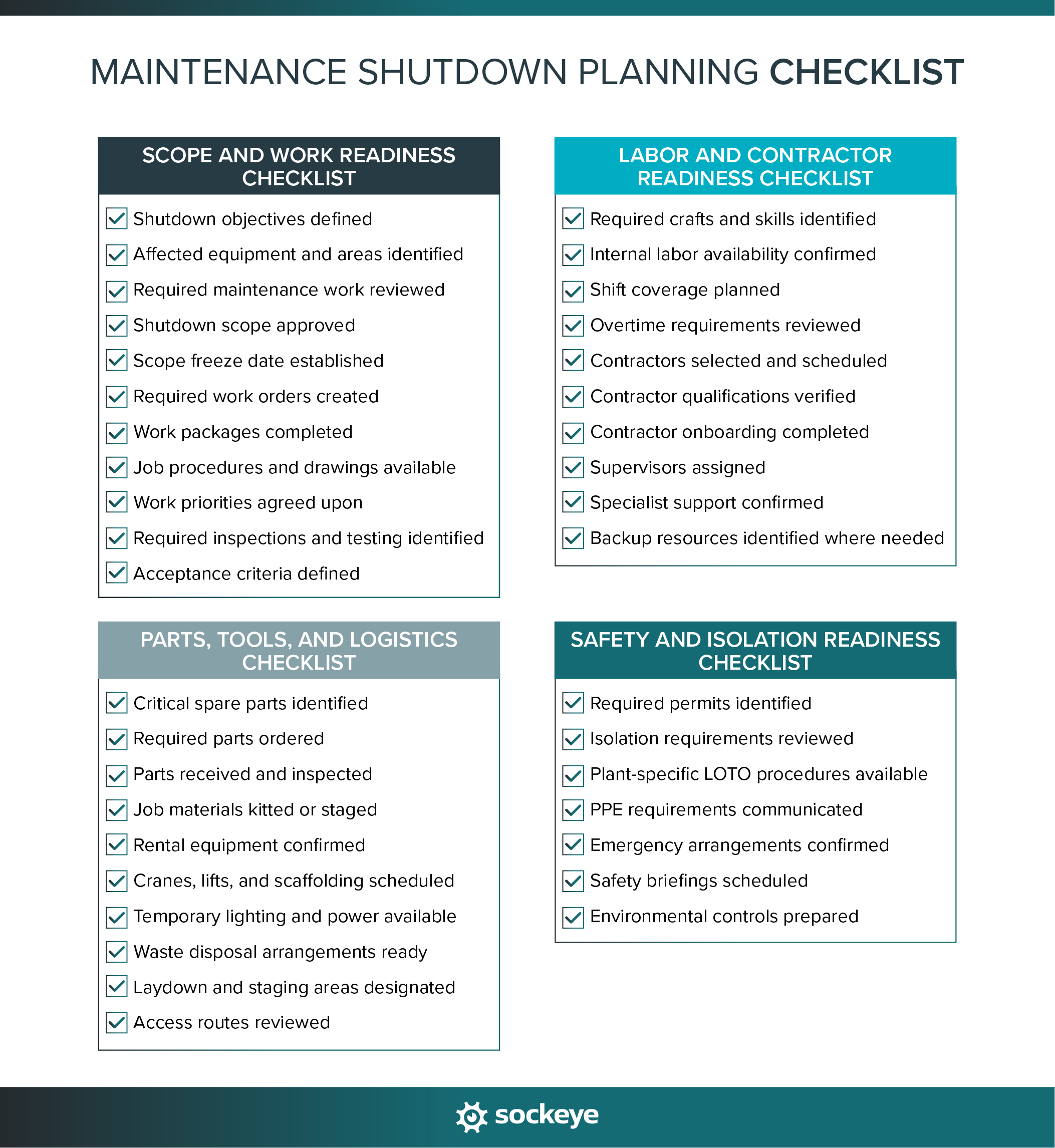
Scope and work readiness checklist
Before worrying about the detailed schedule, confirm that everyone agrees on what work belongs in the shutdown and that the jobs are ready to execute.
- Shutdown objectives defined: Document what the shutdown needs to accomplish, whether that means completing major PMs, inspections, repairs, upgrades, or a combination of work.
- Affected equipment and areas identified: Confirm which assets, production lines, utilities, and plant areas will be unavailable or affected.
- Required maintenance work reviewed: Review proposed shutdown work to confirm it is necessary and appropriately prioritized.
- Shutdown scope approved: Make sure the final worklist has been reviewed and approved by the appropriate maintenance, operations, engineering, and plant stakeholders.
- Scope freeze date established: Set a point after which new work must follow a formal review and approval process.
- Required work orders created: Verify that approved maintenance activities exist as work orders in your CMMS or EAM.
- Work packages completed: Confirm that technicians have the instructions, estimated labor, parts, tools, drawings, and other information needed to complete each job.
- Job procedures and drawings available: Make current procedures, P&IDs, schematics, equipment drawings, and technical documentation accessible to the people doing the work.
- Work priorities agreed upon: Make sure the team knows which jobs are critical and which can be deferred if the shutdown runs short on time or resources.
- Required inspections and testing identified: Define any inspections, NDT, functional testing, calibration, or other verification required during or after the work.
- Acceptance criteria defined: Establish how you will determine that repairs, inspections, and other work have been completed successfully.
Of course, a scope freeze does not mean the shutdown scope can never change. Problems are often discovered once equipment is opened or inspected. The goal is to prevent uncontrolled additions by requiring new work to be assessed and approved before it enters the schedule.
Labor and contractor readiness checklist
A schedule is only realistic if you actually have the people and skills required to execute it. Review internal and external labor before the shutdown begins.
- Required crafts and skills identified: Determine how many mechanics, electricians, instrument technicians, welders, engineers, operators, and other specialists each job requires.
- Internal labor availability confirmed: Account for shifts, planned absences, training, vacations, and other commitments that reduce available maintenance hours.
- Shift coverage planned: Confirm how each shutdown shift will be staffed and who will provide supervision and support.
- Overtime requirements reviewed: Identify where planned work exceeds normal capacity and determine whether overtime is necessary and sustainable.
- Contractors selected and scheduled: Confirm that required contractor crews will be onsite when their work is scheduled.
- Contractor qualifications verified: Check required licenses, certifications, training, insurance, or other qualification requirements.
- Contractor onboarding completed: Finish site orientation, access credentials, safety training, and other onboarding before crews arrive to start work.
- Supervisors assigned: Make sure every crew and major work area has a clear person responsible for coordination and escalation.
- Specialist support confirmed: Verify availability for OEM representatives, inspectors, crane operators, engineers, or other specialist resources.
- Backup resources identified where needed: Determine what alternatives are available if a critical person, contractor, or specialist becomes unavailable.
Pay particular attention to shared resources. A specialist, crane, inspection crew, or contractor may appear available for several individual jobs while still becoming a bottleneck when those jobs overlap.
Parts, tools, and logistics checklist
A well-planned job can still sit idle if one critical component, tool, or piece of access equipment is missing. Verify physical readiness rather than assuming that an issued purchase order means the item will be available.
- Critical spare parts identified: Determine which materials could prevent critical work from starting or finishing if unavailable.
- Required parts ordered: Confirm purchasing has placed orders with enough lead time to meet the shutdown date.
- Parts received and inspected: Verify that critical materials are physically onsite, correct, undamaged, and suitable for use.
- Job materials kitted or staged: Group parts and consumables by job where practical so technicians do not spend shutdown time searching for them.
- Rental equipment confirmed: Verify delivery dates and availability for any rented equipment.
- Cranes, lifts, and scaffolding scheduled: Coordinate access equipment with the jobs that depend on it and account for competing demands.
- Temporary lighting and power available: Confirm temporary utilities are available in work areas that need them.
- Waste disposal arrangements ready: Plan how removed components, contaminated materials, scrap, fluids, and other waste will be handled.
- Laydown and staging areas designated: Reserve suitable areas for materials, removed equipment, tools, and contractor equipment.
- Access routes reviewed: Make sure crews and equipment can reach work areas without creating conflicts with other shutdown activities.
For shutdown-critical materials, consider tracking received and verified separately from ordered. A part sitting in a supplier’s warehouse does not make the job ready.
Safety and isolation readiness checklist
Shutdown maintenance can expose workers to many forms of hazardous energy. Your checklist should therefore verify readiness without trying to replace your facility’s established safety procedures.
- Required permits identified: Determine which jobs require hot-work permits, confined-space permits, line-breaking permits, or other site-specific authorization.
- Isolation requirements reviewed: Confirm the equipment and energy sources that must be isolated for each applicable job.
- Plant-specific LOTO procedures available: Make sure authorized employees can access the correct energy-control procedures for the equipment being serviced.
- PPE requirements communicated: Make sure crews understand the PPE required for their jobs and work areas.
- Emergency arrangements confirmed: Review emergency contacts, response procedures, muster points, rescue provisions, and access for emergency services.
- Safety briefings scheduled: Plan toolbox talks, shift safety meetings, and any shutdown-specific briefings.
- Environmental controls prepared: Address spill prevention, containment, waste handling, emissions, drainage, and other applicable environmental requirements.
For U.S. general-industry facilities, OSHA’s hazardous-energy standard requires employers to establish energy-control programs and procedures where unexpected energization, startup, or release of stored energy could injure workers during servicing and maintenance. Always follow your facility’s procedures and the regulations that apply to your site rather than treating a generic maintenance shutdown checklist as a safety procedure.
2. Plant shutdown execution checklist
Once the shutdown begins, the focus shifts from preparation to control, coordination, and change management.
You need to know what has been released for maintenance, what is actually getting completed, what has changed, and whether delays or additional work are putting the overall shutdown at risk.
Shutdown and plant handover checklist
Before maintenance begins, make sure operations and maintenance have a shared understanding of the condition and control of the affected equipment.
- Production stopped according to plan: Confirm the affected process or equipment has been shut down using the required operating procedure.
- Equipment handed over to maintenance: Complete the required transfer of control or custody from operations to maintenance.
- Shutdown procedures completed: Verify all required steps for bringing the process or equipment to the appropriate shutdown state have been performed.
- Equipment status communicated: Make sure crews understand what is offline, isolated, available for work, or still operating.
- Required isolations applied and verified: Confirm applicable energy-control measures are in place according to authorized plant procedures.
- Permit conditions established: Verify required permits have been issued, and their conditions are understood before work begins.
- Restricted areas established: Set up barricades, access restrictions, exclusion zones, or other controls where required.
- Initial equipment condition documented: Record important pre-maintenance conditions where they could affect inspection findings, troubleshooting, or restart.
Avoid creating assumptions during handover. If a system has not been formally released for maintenance, crews should not have to infer that it is ready because production has stopped.
Found work and scope change checklist
Some additional work is inevitable during most shutdowns. Equipment inspections may uncover cracks, wear, corrosion, contamination, damaged components, or other problems that could not be confirmed beforehand.
The goal is not to eliminate found work. It is to prevent found work from entering the shutdown uncontrolled.
- Newly discovered work documented: Create a clear record of the issue, affected asset, location, and proposed action.
- Safety and reliability implications assessed: Determine what happens if the issue is repaired now, temporarily addressed, or deferred.
- Additional labor requirements identified: Estimate the skills and labor hours required to complete the added work.
- Parts availability checked: Confirm whether the required materials are onsite or can arrive within the shutdown window.
- Schedule impact assessed: Determine how the added work affects related jobs, resource availability, and shutdown completion.
- New work approved, deferred, or rejected: Route the request through the agreed change-control process instead of letting crews add work informally.
- Affected activities rescheduled: Update the shutdown schedule when approved work changes job sequences, durations, or resource requirements.
- Stakeholders informed: Communicate significant changes to maintenance, operations, contractors, and plant leadership as appropriate.
A technically worthwhile repair may still be the wrong job to add if it requires scarce resources and threatens higher-priority work. Evaluate new work against the entire shutdown, not just the affected asset.
Progress and schedule control checklist
Your original shutdown schedule becomes less useful each time actual conditions change without being reflected in it. Keep the working schedule aligned with what is really happening in the plant.
- Actual progress compared with the schedule: Regularly review which jobs have started, finished, slipped, or taken longer than planned. Pay particular attention to work that could affect the overall shutdown duration.
- Labor and contractor availability updated: Account for absences, overtime limits, crew changes, and technicians or contractors who become available earlier or later than expected.
- Shared-resource conflicts resolved: Reallocate cranes, specialists, inspectors, tools, and other constrained resources as the schedule changes.
- Shift changes reflected in assignments: Update work when staffing, priorities, or job status changes between shifts.
- Schedule changes communicated: Make sure affected supervisors and crews are working from the latest schedule.
- Delay reasons recorded: Capture why work moved so you can analyze recurring constraints after the shutdown.
This becomes much easier when planners can see work orders and available labor in the same scheduling view. With CMMS/EAM scheduling bolt-on like Sockeye, instead of manually rebuilding spreadsheets each time conditions change, you can move work between technicians, crews, and days while immediately seeing the effect on labor capacity.
3. Plant restart and recommissioning checklist
Before equipment restart, teams should verify that work has been properly completed, the equipment has been restored to the required configuration, testing is finished, and operations understands any remaining limitations.
Work completion checklist
Start by confirming that the equipment and surrounding work area are actually ready to be returned to operations.
- Planned work completed or formally deferred: Account for every planned job rather than leaving unfinished items ambiguous. Clearly mark down repairs that require permanent follow-up.
- Work orders updated: Record completion, labor, findings, comments, and other required maintenance information.
- Required inspections passed: Confirm applicable quality, engineering, safety, or regulatory inspections have been completed.
- Repairs meet acceptance criteria: Verify completed work satisfies the standards defined before execution.
- Locks and tags removed according to procedure: Follow authorized plant procedures for removal and restoration after servicing is complete.
- Equipment configuration restored: Return components and systems to the configuration required for startup.
- Valves, switches, and controls positioned correctly: Verify operating positions before equipment is energized or started.
- Temporary bypasses reviewed: Remove temporary bypasses and overrides where required and formally control any that must remain.
- Tools and materials removed: Check equipment and work areas for tools, loose components, scaffolding, temporary equipment, and unused materials.
- Work areas cleaned: Remove debris, spills, scrap, and other remnants of maintenance activity.
- Guards and protective devices restored: Confirm required guards, covers, barriers, and protective devices are back in place.
Testing and restart readiness checklist
Once physical work is complete, verify that affected equipment can perform safely and as intended.
- Required functional tests completed: Perform the tests specified by the work package, procedure, engineering team, or manufacturer.
- Instrumentation checked: Verify affected sensors, transmitters, gauges, and other instrumentation are operational and properly configured.
- Safety systems operational: Confirm applicable shutdown systems, protective devices, and other safety functions are ready.
- Alarms and interlocks verified: Test affected alarms, trips, or interlocks where required before normal operation.
- Leak or pressure tests completed: Perform required testing on opened or repaired systems before returning them to service.
- Equipment inspected for abnormal conditions: Look for leaks, loose components, abnormal positioning, or other visible concerns.
- Outstanding limitations communicated: Make sure operations understands any temporary repairs, monitoring requirements, restrictions, or follow-up work.
Restart procedures will vary significantly between facilities and equipment types. Treat this list as a readiness reminder, not as a substitute for your site’s commissioning, startup, safety, or operating procedures.
4. Post-shutdown to-do checklist
The shutdown may be over once production resumes, but the maintenance process is not.
Close out the records, review what happened, and capture lessons while the details are still fresh. Otherwise, many of the same problems will return during the next outage.
Maintenance closeout checklist
Make sure shutdown work becomes part of your permanent maintenance history and that outstanding issues return to the normal work-management process.
- Work orders closed: Complete the required administrative closeout for finished shutdown work.
- Asset history updated: Preserve useful repair, failure, inspection, and condition information against the affected asset.
- Inspection findings recorded: Enter results that may influence future PMs, inspections, repairs, or replacement decisions.
- Spare-part usage recorded: Update inventory and replenish critical spares where needed.
- Unused materials returned: Return unused parts and consumables to inventory or the appropriate storage location.
- Temporary repairs added to the backlog: Create follow-up work so temporary solutions do not disappear after startup.
- Deferred work assigned a follow-up date: Move incomplete or intentionally deferred work back into the maintenance backlog with clear priority and ownership.
- Technical documentation updated: Revise drawings, procedures, asset records, BOMs, or other documentation when the shutdown changed the equipment.
The shutdown often generates valuable asset information that you cannot obtain during normal operation. Make sure it ends up somewhere future planners and technicians can easily find it.
Plant shutdown performance review checklist
Now it’s time to compare what actually happened with what you planned.
- Planned vs. actual duration reviewed: Compare the intended shutdown window with the actual return-to-service time.
- Schedule compliance calculated: Review how much scheduled work was completed as planned.
- Planned vs. completed work reviewed: Compare the original scope, approved additions, completed jobs, and deferred work.
- Major delays categorized: Group delays by causes such as labor, materials, access, equipment condition, contractor availability, or planning quality. Look beyond the immediate symptom to understand why significant delays or failures happened.
- Found work reviewed: Assess how much additional work was discovered and whether better inspections or planning could identify some of it earlier next time.
- Safety events reviewed: Examine incidents, near misses, and significant hazards identified during the shutdown.
- Contractor performance evaluated: Review safety, quality, productivity, responsiveness, and schedule performance where relevant.
- Lessons retained for the next shutdown: Store findings somewhere planners can easily access when the next event enters the planning cycle.
Use the checklist to support your schedule, not replace it
A maintenance planning shutdown checklist and a maintenance schedule solve related but different problems.
- The checklist determines whether work is ready: It helps you verify that requirements such as labor, materials, procedures, permits, and testing have been addressed.
- The schedule determines when ready work happens: It coordinates job timing, sequences, dependencies, labor assignments, and available resources.
- Execution changes both: Found work, delays, absences, longer-than-expected jobs, and shifting priorities require you to reassess readiness and update the schedule.
For complex shutdowns and turnarounds, this scheduling work can involve critical-path logic, detailed project controls, engineering milestones, and other disciplines beyond normal maintenance scheduling. We cover those considerations in more detail in our turnaround planning and scheduling guide.
For maintenance planners, one of the biggest day-to-day challenges is keeping the work-order schedule aligned with actual technician and contractor availability as shutdown conditions change.
Keep your shutdown schedule on schedule with Sockeye
You can spend months preparing a shutdown schedule and still need to change it within hours of execution starting.
Sockeye gives you a simple visual scheduling layer that works alongside your existing CMMS or EAM. You can use it to:
- Match work to available labor and skills: Build schedules around the people who are actually available to perform the work.
- Level labor capacity: See overloaded and underutilized crews before unnecessary overtime or resource conflicts develop.
- Adjust work with drag-and-drop scheduling: Move jobs between technicians, crews, and dates without managing spreadsheets or rebuilding schedules from scratch.
- See the impact of delays: Identify schedule changes and labor imbalances as conditions change.
- Keep scheduling data synchronized: Connect Sockeye with your CMMS/EAM so planners can work with current backlog and send work order status updates back into your system of record.
The AV Group experienced the difference during its own shutdown scheduling process. Planning and Shutdown Superintendent Todd Hicks previously spent up to 40 hours building a single shutdown schedule using spreadsheets. After implementing IBM Maximo and connecting it to Sockeye, that work dropped to about one hour.
“What used to take me up to five days of work can now be done with Sockeye in just under an hour. Because Sockeye synchronizes the data directly from our CMMS, we know the information is valid and trustworthy.”
Todd Hicks, Planning and Shutdown Superintendent AT THE AV GROUP
Your shutdown checklist can help make sure the work is ready. Sockeye can help you quickly build and maintain your shutdown schedule.
Schedule a demo to see how Sockeye can simplify maintenance and shutdown scheduling at your facility.
