
A deferred maintenance plan is a documented process for recording, assessing, prioritizing, scheduling, and monitoring maintenance work that cannot be completed immediately. A complete plan identifies what has been deferred, why it was postponed, the risk of continued delay, the resources required, the person responsible, and the target completion date.
A deferred maintenance plan should include:
- A validated list of deferred work
- Asset and work-order details
- The reason for deferral
- Risk and asset-criticality scores (optional, but helpful for prioritization)
- Labor, skills, parts, tools, and cost estimates
- A target completion date
- Performance metrics and review dates.
Every organization has to postpone some maintenance work. Even the best-run facilities face limits on time, people, inventory space, and budget.
The goal isn’t to fix everything immediately; that’s just not practical. Instead, you need to be smart about what you postpone — and have a deferred maintenance plan that will get you back on track if your backlog starts getting out of control.
Let’s arm you with the knowledge to do just that.
QUICK TAKEAWAYS
- A deferred maintenance plan is a strategic framework for documenting and managing your backlog, not a mandate to fix every issue at once.
- It’s important to distinguish between intentional deferrals and resource-forced delays.
- Calculating your team’s true weekly labor capacity allows you to build realistic schedules and set achievable goals for reducing the backlog.
- Monitoring key performance indicators like backlog age and inflow rates helps you identify systemic inefficiencies and optimize your maintenance schedules.
What is deferred maintenance?
Deferred maintenance refers to the practice of postponing asset repair or upkeep due to financial constraints, lack of resources, or strategic prioritization.
Deferred maintenance can be:
- Intentional: You deliberately delay maintenance work to focus on a higher-priority project, prioritize short-term operational output to meet demand, or for other strategic reasons.
- Forced: You postpone maintenance work because of a lack of resources — be it time, money, parts, labor, or equipment unavailability.
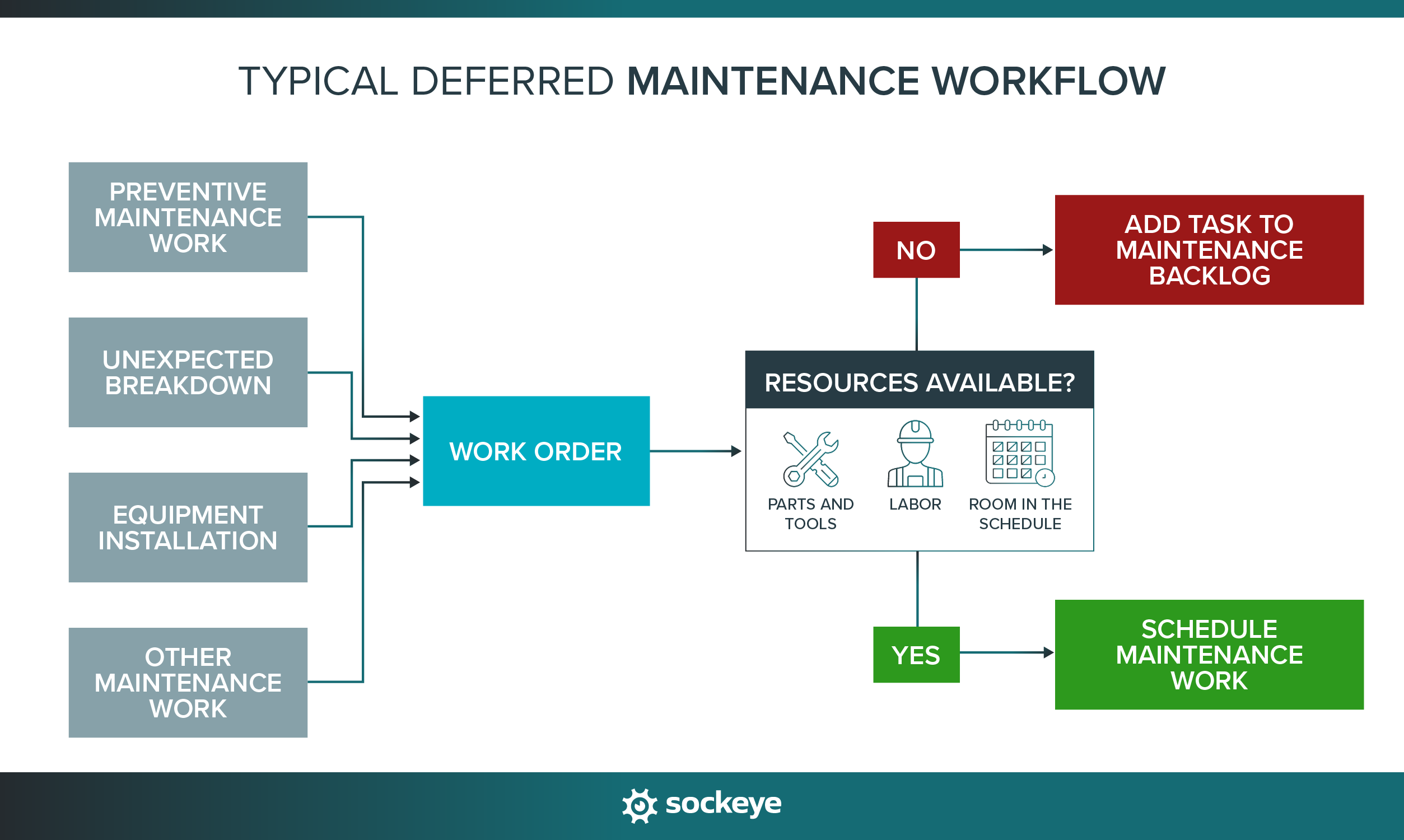
Deferred maintenance plan vs. maintenance backlog
Before we move on, let us define our terms to ensure we are on the same page.
| Concept | Meaning | Purpose |
|---|---|---|
| Deferred maintenance | Work that has been deliberately or involuntarily postponed. | Describes the status of individual maintenance work. |
| Maintenance backlog | The total volume of identified maintenance work. | Measures the amount of outstanding work. |
| Deferred maintenance plan | The documented process for assessing, controlling, funding, scheduling, and completing deferred work. | Explains how the organization will manage the risk and complete the work. |
| Ready backlog | Fully planned work with the required materials, approvals, labor requirements, and instructions in place. | Provides executable work for the scheduler. |
Deferred maintenance examples
Here are some examples that show how maintenance work can be strategically postponed when there are valid operational or business reasons:
- Seasonal production demands: Take a factory that makes holiday decorations. During their busy season, they might postpone non-urgent repairs to keep production moving.
- Resource optimization: Think about a plant with three machines all needing the same repair specialist. Instead of scheduling three costly separate visits, they’ll plan all the work for a single week. Smart scheduling saves both time and money while getting all the repairs done properly.
- Planned equipment upgrades: Picture a company that’s upgrading its packaging line in three months. The current line needs new belts, but it should run safely until the replacement arrives. They decide to save those maintenance dollars for the upcoming upgrade, while keeping a close eye on the existing equipment.
Despite these valid reasons, the reality is that maintenance planners and schedulers often face forced deferrals due to resource constraints.
Usually, scheduled work must be deferred because of more pressing reactive work. For example, the two technicians supposed to perform the scheduled preventive maintenance on the automated material handling system had to race to handle the emergency repair on a CNC machine instead because its coolant filtration system began to overflow.
Common causes of deferred maintenance
Deferred maintenance usually grows because available labor, parts, tools, budget, or equipment access cannot keep pace with incoming work.
Add poor organization on top of that, and you end up in a vicious cycle. With limited funds and labor, your team focuses on fixing things only when they break instead of preventing problems. And when your team isn’t well organized, you waste the limited resources you do have — and your maintenance backlog continues to grow.
For a detailed analysis of backlog causes, benchmarks, and calculations, see our guide to maintenance backlog management.
Steps for creating a deferred maintenance plan
A deferred maintenance plan provides a systematic framework to address maintenance backlogs while implementing clear guidelines for work delays. It establishes processes that help organizations manage deferred maintenance effectively and safely.
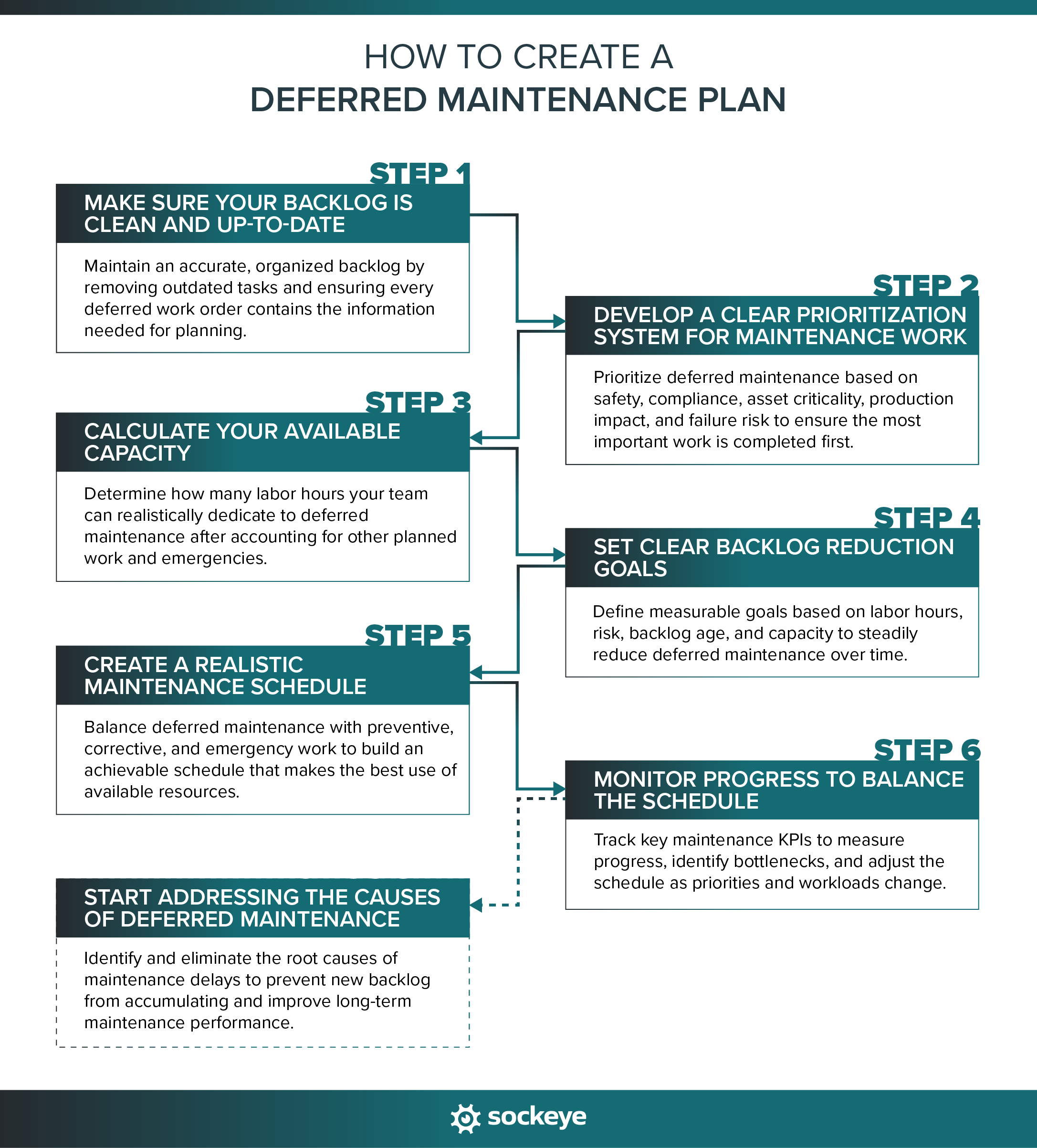
Step #1: Make sure your backlog is clean and up-to-date
Your maintenance backlog should provide a comprehensive overview of all deferred tasks in your facility. Ideally, for each deferred item, you would have:
- Equipment location and tag number
- Task/problem description
- Estimated labor hours and skill requirements (e.g. you need an electrician)
- Required parts and tools to execute work
- Priority level
- Delay reason
The scope of work for creating such a backlog varies dramatically across facilities. In a well-organized plant, it might simply involve consolidating existing maintenance records from your CMMS and validating their accuracy. Be sure to remove duplicates, outdated tasks, and issues that have already been resolved but are still sitting on the backlog.
For example, Sockeye (our CMMS scheduling bolt-on) can provide you with a list of deferred tasks for each piece of equipment, which you can export or use to prioritize and schedule future work.
Other manufacturing facilities might require a complete equipment audit. This means walking through each production area to document equipment conditions and identify maintenance needs.
Step #2: Develop a clear prioritization system for maintenance work
A deferred maintenance prioritization system should rank each task by safety, compliance, asset criticality, failure likelihood, production impact, and cost:
- Safety impact: Maintenance tasks that could affect worker safety need immediate attention.
- Regulatory compliance requirements: Industries like food processing or pharmaceutical manufacturing have very specific rules you need to follow.
- Production impact: A failed bearing on your main production line has different implications than the same issue on a backup system.
- Cost implications: How likely is it that postponing this $500 gearbox oil change will result in a $50,000 replacement?
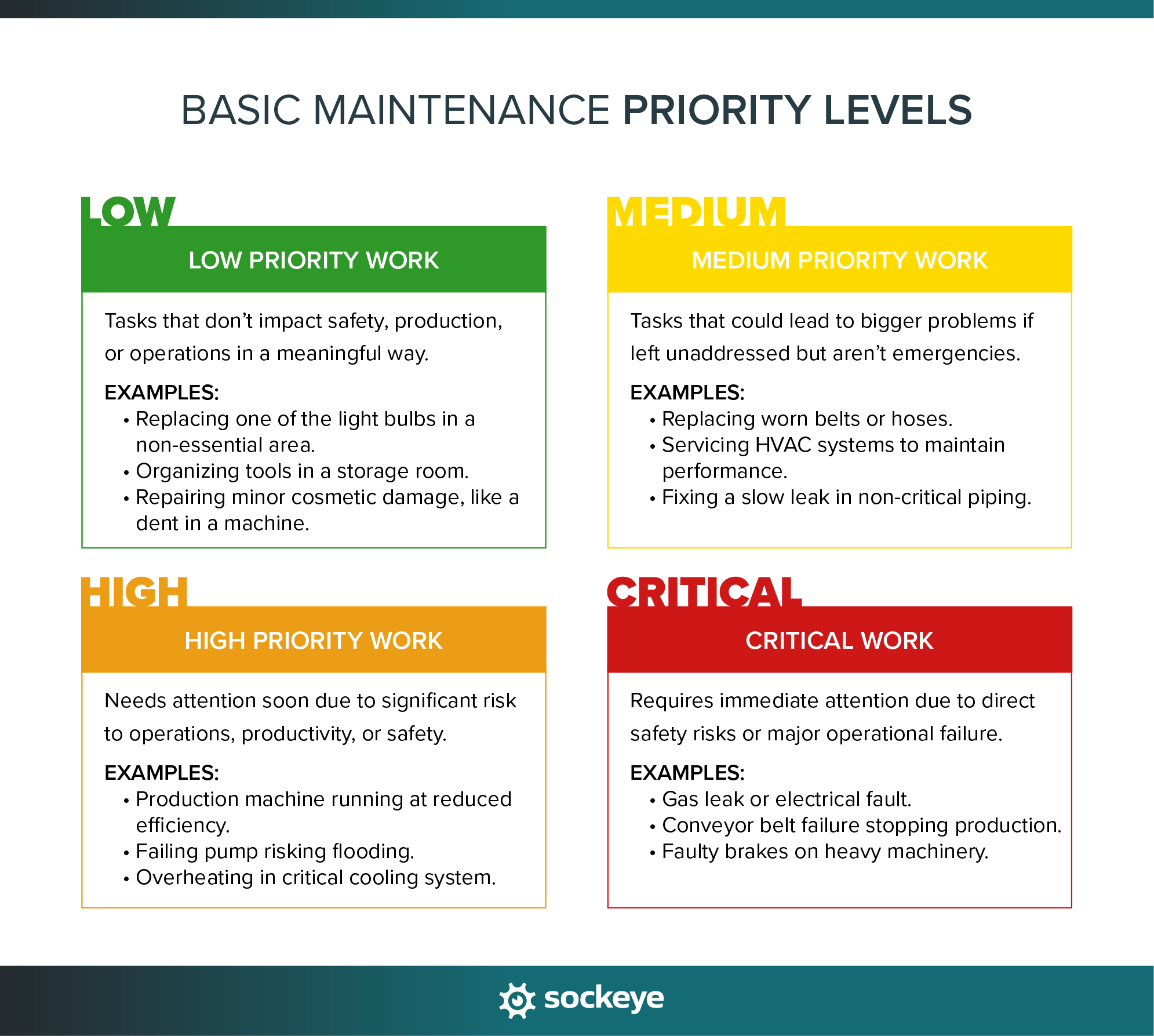
Read our guide to maintenance prioritization to get a detailed overview of which factors to consider when setting work order priority levels.
As a part of the prioritization workflow, you should also define when it is acceptable to defer maintenance. Here is a short decision framework in the form of a table:
| Considered deferring work when: | Avoid deferring work when: |
|---|---|
| The asset can continue operating safely | Worker or public safety may be affected |
| The deferral does not violate a regulatory, quality, warranty, or environmental requirement | The task is required for regulatory or quality compliance |
| The likelihood of failure during the deferral period is understood and acceptable | The asset is a critical single point of failure |
| The potential consequence of failure is limited | An active defect is rapidly deteriorating |
| A redundant asset or contingency plan is available | Failure could cause environmental harm |
| The asset can be inspected or monitored during the deferral period | The organization cannot adequately monitor the asset |
| A responsible person has approved the deferral | The delay would invalidate a warranty or required inspection |
Standardizing prioritization and deferral workflows creates consistency across shifts and departments. It ensures maintenance schedulers or supervisors make similar decisions when priorities compete, reducing confusion and ensuring critical maintenance receives proper attention.
Step #3: Calculate your available capacity
Assessing your maintenanBefore you can build a realistic deferred maintenance plan, you need to know how many labor hours your team can actually dedicate to the work.
Start with your total weekly technician capacity, then subtract time already committed to preventive maintenance, planned corrective work, training, leave, and other unavailable time. You may also want to reserve a portion of your capacity for emergency work.
Use this formula:
Net weekly capacity for deferred work = total technician capacity − preventive maintenance hours − corrective maintenance hours − reserved emergency capacity − other unavailable time
For example, a team of 10 technicians working 40 hours per week has 400 total labor hours. If 180 hours are committed to preventive maintenance, 100 hours to planned corrective work, 40 hours are reserved for emergencies, and 20 hours are unavailable because of meetings and training, the team has:
400 − 180 − 100 − 40 − 20 = 60 hours
That means the team can realistically dedicate 60 labor hours per week to deferred maintenance.
You can then estimate how long it will take to complete the ready deferred backlog:
Deferred backlog in weeks = ready deferred work hours ÷ weekly capacity allocated to deferred work
If the team has 480 hours of fully planned deferred work and can allocate 60 hours per week to it, the backlog represents:
480 ÷ 60 = 8 weeks of deferred work
Only include work that is ready to schedule in this calculation. Tasks that are still waiting for parts, approvals, job plans, contractors, or equipment access should be tracked separately, since they cannot yet be placed on the schedule.
Review these calculations regularly. Technician availability, production demands, emergency work, and incoming maintenance requests can all change the amount of capacity available for deferred work.
Step #4: Set clear backlog reduction goals
SettinThe biggest mistake teams make is measuring deferred work only by the number of work orders.
One deferred task may require 40 minutes, while another may take several technicians multiple shifts to finish. Work-order counts alone give a misleading picture of how much progress the team is making.
Use a combination of risk, labor hours, backlog age, and available capacity to set more meaningful goals. For example:
- Eliminate all critical deferred work by the end of the quarter.
- Reduce the number of high-risk deferred tasks from 18 to fewer than five.
- Complete at least 200 labor-hours of deferred work each month.
- Reduce the ready deferred backlog from eight weeks to four weeks.
- Reduce the number of work orders being delayed because of a specific cause (i.e., unavailable tools/parts) by 50%.
- Keep the number of deferred preventive maintenance tasks older than 30 days below an agreed threshold.
Each goal should have a defined timeframe, an accountable owner, and a clear way to measure progress.
You should also compare the amount of deferred work completed with the amount of new work being deferred during the same period:
Net change in deferred work = new deferred work added − deferred work completed
For example, completing 250 labor-hours of deferred work may appear to be strong progress. However, if 220 new labor-hours were deferred during the same month, the backlog only reduced by 30 hours.
Step #5: Create a realistic maintenance schedule
The prioritization system we discussed earlier can act as your guide, showing you which jobs need to happen first.The real challenge lies in balancing deferred maintenance with ongoing work.
The real challenge lies in balancing deferred maintenance with ongoing work, especially if a large chunk of that ongoing work is unplanned — according to a MaintainX 2024 Industrial Maintenance study, nearly 60% of facilities dedicate less than 40% of total maintenance time to planned activities.
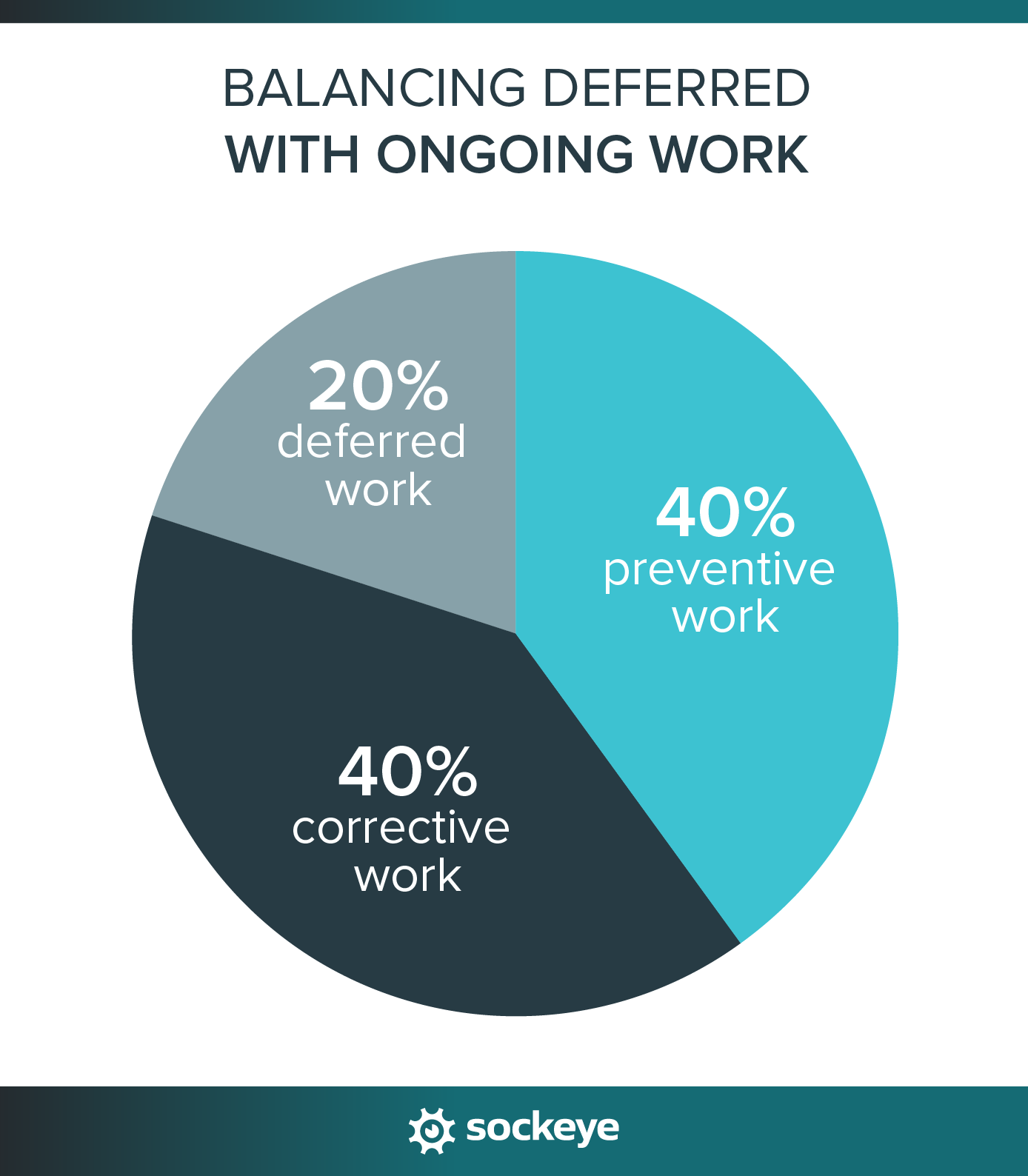
Think of your maintenance capacity as a pie chart where one portion needs to remain dedicated to preventive maintenance to prevent creating new deferred work, another handles corrective maintenance, and the remaining portion tackles your deferred maintenance backlog.
Imagine you are working with 400 labor hours in total. The breakdown could look something like this:
| Work category | Weekly labor hours | Scheduling treatment |
|---|---|---|
| Preventive maintenance | 180 | Protected recurring capacity |
| Planned corrective work | 120 | Prioritized by asset criticality |
| Deferred maintenance | 60 | Selected from high-risk ready backlog |
| Emergency reserve | 40 | Held for unplanned work |
Work order scheduling software like Sockeye helps maintenance teams place high-priority deferred work into the schedule without exceeding available labor capacity. Plus, you get a visual breakdown of the currently scheduled work based on its type (corrective, preventive, predictive, etc.).
Instead of manually juggling spreadsheets and trying to remember which technicians are available and qualified for which tasks, the software helps you quickly create optimized schedules that maximize your team’s efficiency.
Step #6: Monitor progress to balance the schedule
Using a CMMS and Sockeye together provides powerful insights into key performance indicators. You can track metrics like:
| KPI | Standard calculation | What it shows |
|---|---|---|
| Total deferred work hours | Sum of estimated labor hours for deferred work | Overall volume of deferred maintenance |
| Deferred backlog weeks | Ready deferred hours ÷ weekly allocated capacity | Time required to complete executable deferred work |
| Deferred work age | Days since the original due or deferral date | How long work has remained unresolved |
| High-risk overdue items | Count of high-risk tasks beyond their target date | Exposure to the most serious risks |
| Deferral inflow | Work hours newly deferred during the period | Rate at which new deferred work is being created |
| Deferred work completion | Deferred hours completed during the period | Rate at which the plan is reducing the backlog |
| Net backlog change | New deferred hours − completed deferred hours | Whether the problem is growing or shrinking |
| Deferral reason distribution | Percentage by reason code | Primary causes of postponement |
| Schedule compliance | Scheduled jobs completed ÷ jobs scheduled | Whether the recovery schedule is realistic |
| Emergency work percentage | Emergency hours ÷ total maintenance hours | Whether reactive work is disrupting the plan |
Where Sockeye really shines is in helping you adapt when things don’t go according to plan. You can quickly reshuffle your maintenance schedule using our drag-and-drop interface, real-time utilization percentages for all teams (crafts and contractors), and visual indicators for overtime (that pop up to tell you a specific technician is overbooked).
Bonus step: Start addressing the causes of deferred maintenance
Maintenance and reliability managers should work together to identify systemic issues that contribute to maintenance deferrals beyond budget constraints. This might reveal problems like inefficient work processes, inadequate training programs, or poor communication between departments.
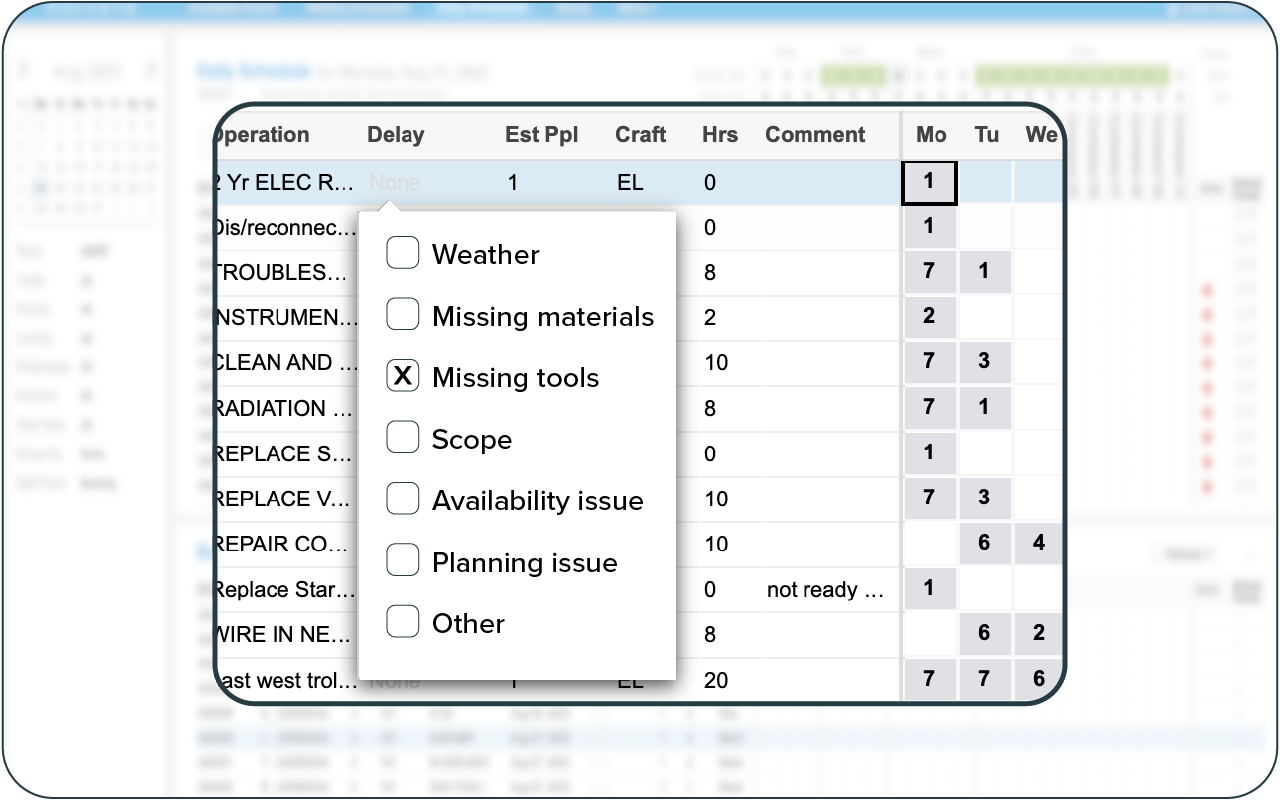
You can do that with Sockeye using our customizable delay reason codes. If a specific work order was not completed on time, a supervisor or tech just needs to select a reason from a drop-down list. Later, you can put that data into a report to identify recurring issues.
The less work you have, the easier it’s going to be to clear out the backlog.
If budget limitations drive most of your maintenance delays, you’ll need to build a strong case for additional resources — and show upper management exactly what deferred maintenance costs the company in the long run.
Stay on track with Sockeye
Using Sockeye’s intelligent scheduling capabilities, your maintenance team can start prioritizing work more efficiently and minimize deferred maintenance.
Need help managing deferred maintenance? Schedule a personalized demo and see how Sockeye can help your team tackle that maintenance backlog while building a more efficient operation for the future.
