
Turnarounds give you a rare opportunity to inspect, repair, and upgrade equipment that cannot be taken offline during normal production. They also place your maintenance team under intense pressure. Once the shutdown begins, every delay can increase labor costs and extend lost production time.
Big shutdowns are difficult to deliver as planned. AP Networks’ analysis of more than 2,500 shutdowns, turnarounds, and outages found that more than half exceeded their cost or duration targets by at least 10%. Around 24% exceeded one or both targets by more than 30%.
The problems that cause those overruns often begin months before the facility shuts down. Unnecessary scope, incomplete job plans, missing materials, unrealistic labor assumptions, and disconnected departmental schedules can turn small preparation gaps into costly execution delays.
Effective turnaround planning and scheduling help you prevent those problems.
This guide identifies and explains 12 best practices you can apply to keep things on track. You will also learn which performance indicators to track and how scheduling software can help you coordinate labor, adapt to changes, and keep turnaround work moving.
QUICK TAKEAWAYS
- Effective turnaround planning starts with a risk-based worklist, clear ownership, and firm scope control.
- Execution-ready work packages must include complete instructions, materials, labor requirements, safety preparations, and dependencies.
- An integrated schedule should connect maintenance, operations, contractors, inspections, and restart activities around the critical path.
- Scheduling labor based on trade, skill, and real-time labor utilization helps prevent hidden resource shortages, delays, and excessive overtime.
- Sockeye simplifies turnarounds by offering a simpler way to schedule and reschedule work, with live insights into labor availability and utilization.
This piece is quite long, so you can use the content table on the left (or at the beginning of the post for mobile users) to navigate to specific sections of the article.
What is turnaround planning and scheduling?
Turnaround planning and scheduling is the process of preparing, sequencing, and coordinating maintenance work that must be completed while equipment, a production area, or an entire facility is offline.
A turnaround is a planned maintenance event used to complete inspections, repairs, overhauls, replacements, and equipment upgrades that would be difficult or unsafe during normal operations.
Planning and scheduling serve different purposes within the process:
- Turnaround planning: Determines what work will be completed, why it is necessary, and how each job will be performed. Planning identifies the required labor, parts, tools, permits, safety procedures, and technical documentation.
- Turnaround scheduling: Determines when each job will happen and who will perform it. Scheduling also coordinates task dependencies, equipment access, crew availability, contractor work, inspections, and operational handoffs.
You may also hear the terms shutdown, turnaround, and outage (abbreviated as STO) used interchangeably to describe these maintenance events. Their exact meaning varies between organizations, but they do generally refer to the same concept.
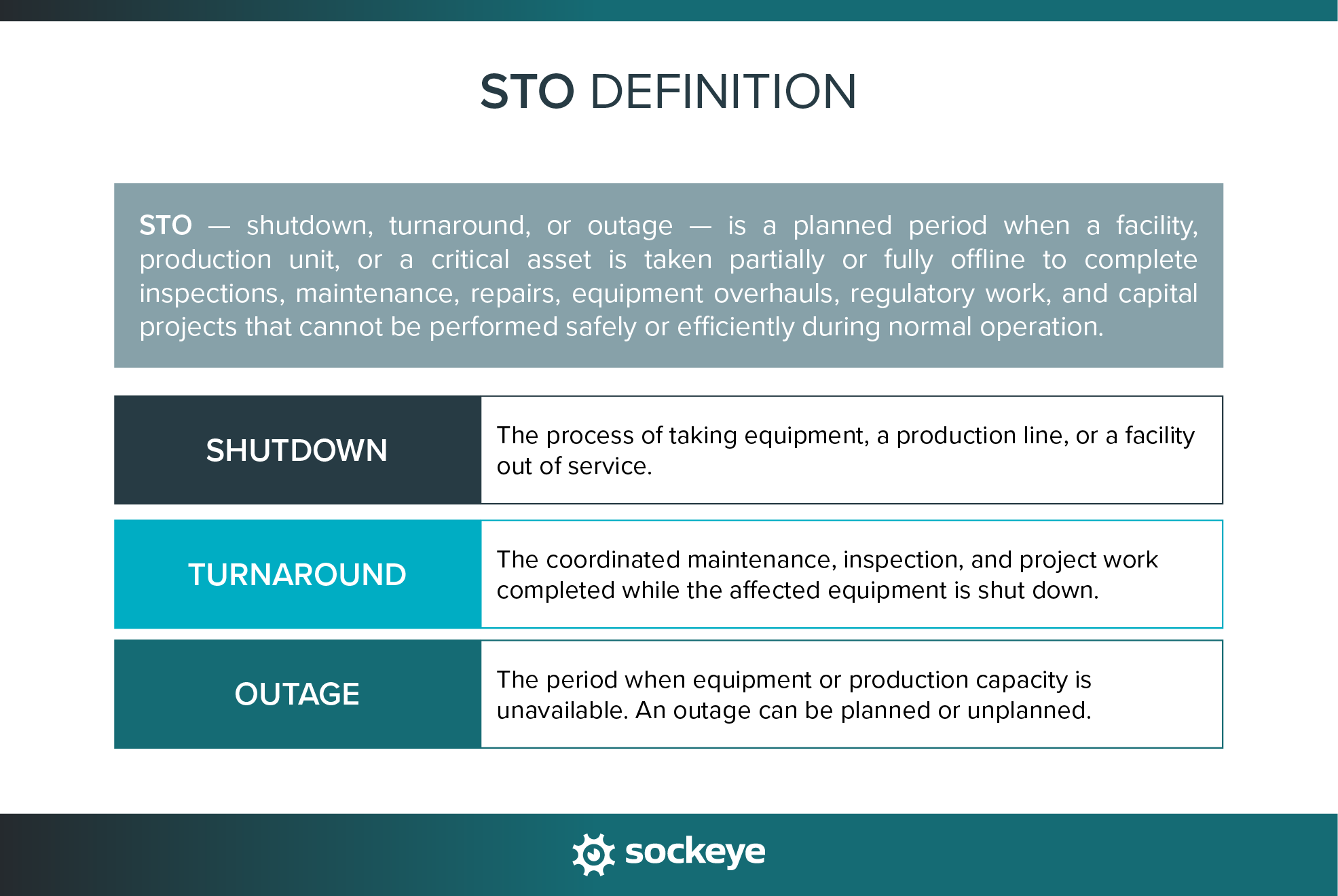
Turnaround planning and scheduling is more complex than routine maintenance scheduling because many teams must complete interdependent work within a short window. Maintenance, operations, engineering, safety teams, inspectors, and contractors must follow the same priorities and coordinate their activities around limited labor, access, materials, and equipment availability.
Typical maintenance turnaround timeline
A maintenance turnaround follows a series of connected phases, from defining the event strategy to reviewing performance after restart. Large, complex turnarounds may require 12+ months of preparation, while smaller shutdowns can follow a much shorter planning cycle.
For reference, BCG recommends starting the planning process at least 18 months before a major turnaround. The appropriate timeline for your facility depends on the scope, equipment complexity, regulatory requirements, contractor availability, and lead times for critical parts.
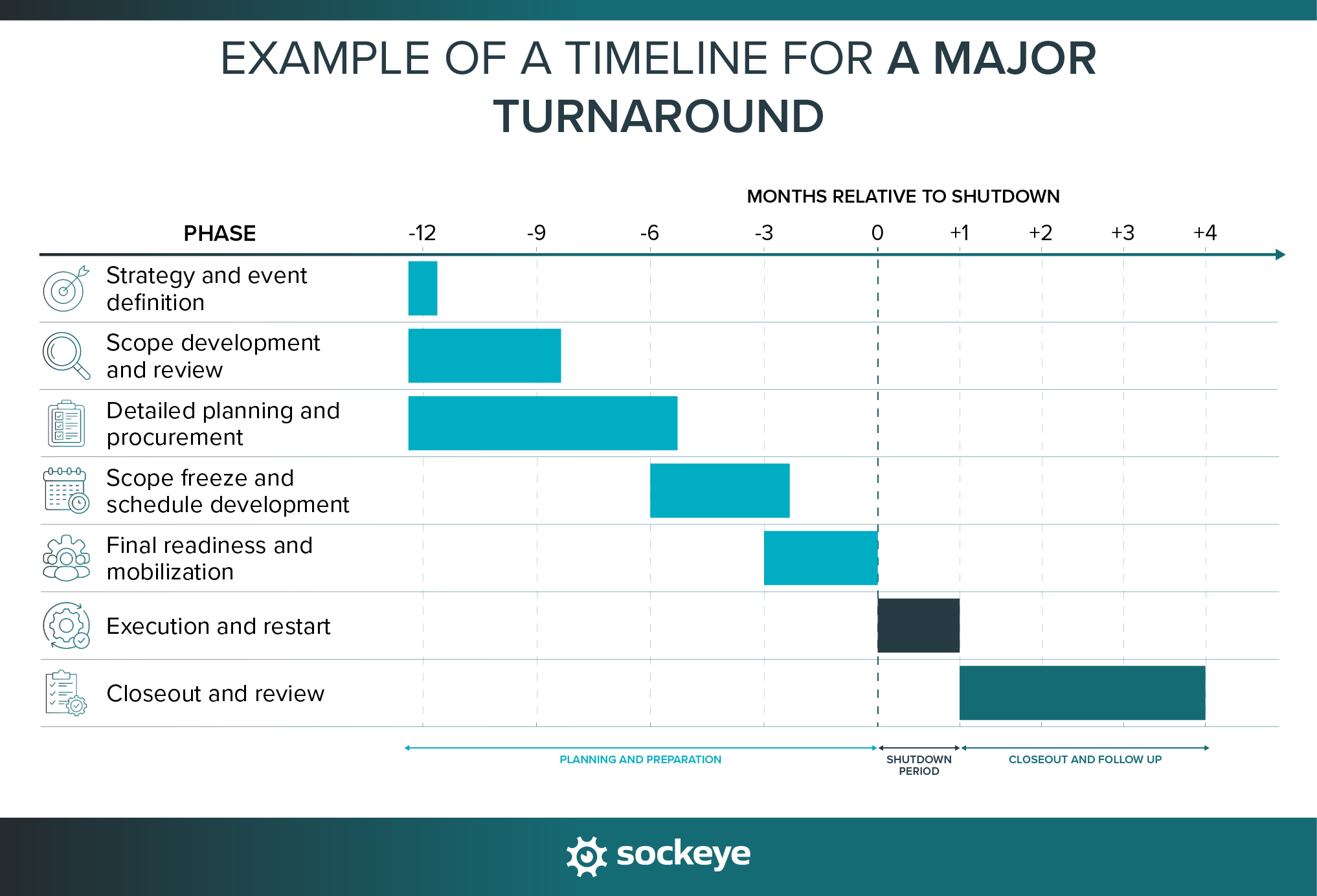
The following example shows how a smaller maintenance turnaround may be organized — one involving a single production area or a shutdown window lasting several days rather than several weeks.
| Phase | Timing | Main activities | |
|---|---|---|---|
| Define the event and initial scope | Four months before shutdown | Confirm the shutdown dates, appoint the turnaround lead, collect work requests, review inspection findings, define objectives, and establish an initial budget | Preliminary scope and clear event ownership |
| Review scope and plan individual jobs | Three months before shutdown | Prioritize work by risk, remove jobs that can be completed during normal operations, prepare job plans, estimate labor hours, identify required trades, and order materials | Approved worklist and planned work packages |
| Freeze scope and build the schedule | Two months before shutdown | Freeze the worklist, establish rules for late additions, sequence jobs, identify dependencies, coordinate operations and maintenance activities, and compare labor demand with available capacity | Controlled scope with a realistic baseline schedule |
| Verify readiness and finalize assignments and the schedule | One month before shutdown | Confirm technician and contractor availability, stage parts and tools, prepare permits and isolation plans, review critical jobs, resolve scheduling conflicts, and publish the final schedule | Execution-ready work packages and confirmed resources |
| Execute the turnaround and restart equipment | Shutdown period | Shut down and isolate equipment, complete scheduled work, monitor progress by shift, manage discovery work, perform inspections and testing, and return equipment to service | Approved work completed and equipment safely restarted |
| Close out and review performance | Within one to four weeks after restart | Close work orders, compare planned and actual labor hours, review schedule compliance, document delays, evaluate contractor performance, and assign improvement actions | Documented results and lessons for the next turnaround |
Some of these phases will overlap. If specialized equipment or contractors must be secured earlier, procurement may need to begin before the formal four-month planning window. Similarly, planners can start preparing high-confidence work packages as the remaining scope continues through review.
In any case, as seen in the examples above, each phase should still have defined deliverables and approval criteria.
Turnaround planning best practices
Strong shutdown planning gives your scheduler work that is properly defined and ready to place on the schedule. If job scopes, labor estimates, materials, or access requirements remain unclear, even the most carefully built STO schedule will be unreliable.
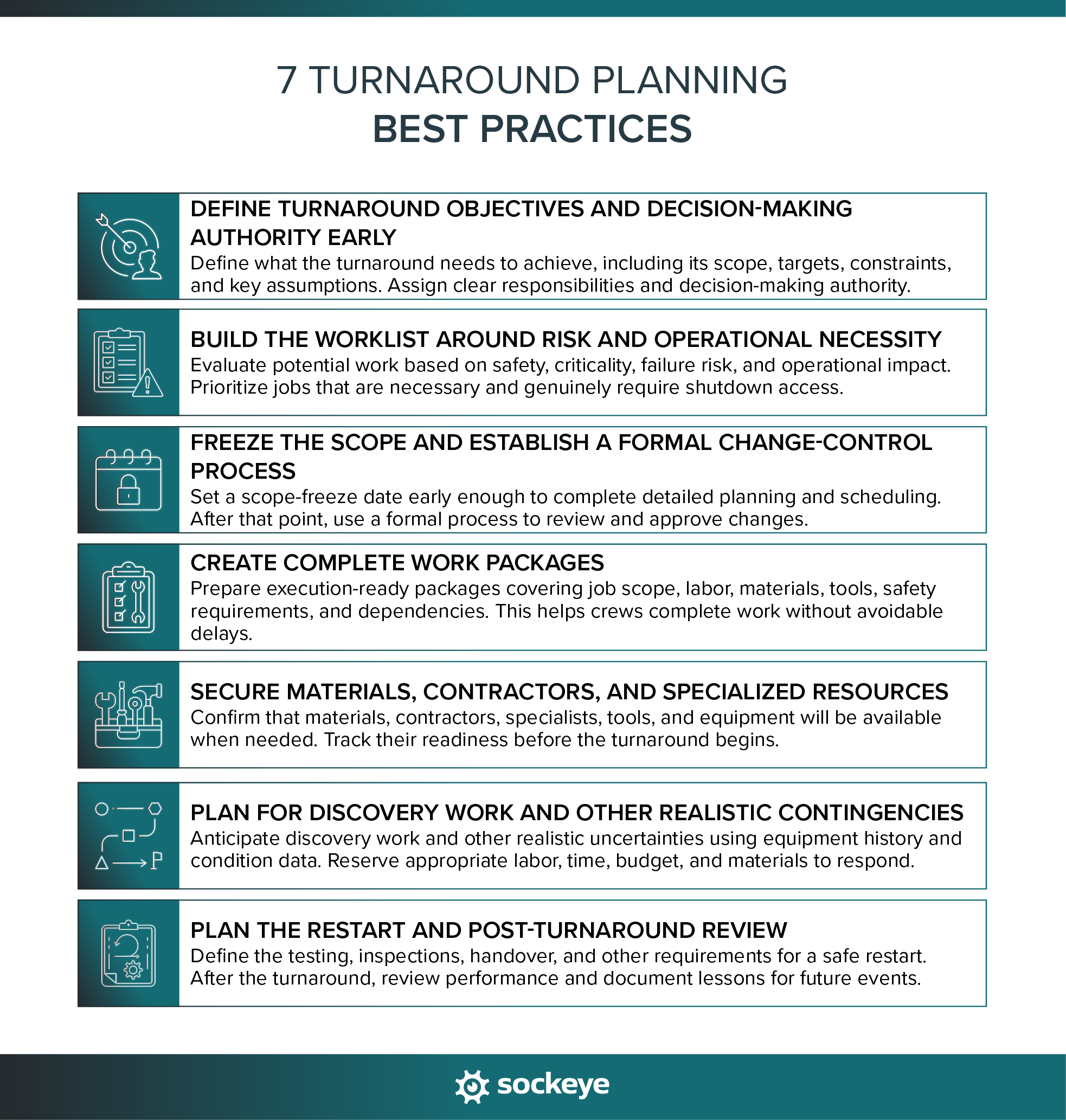
1. Define turnaround objectives and decision-making authority early
Start every turnaround by defining what the event must accomplish and who has the authority to make important decisions. It helps to write these things down (some call it a turnaround premise).
A useful turnaround premise should define:
- Business objectives: Explain why the turnaround is needed and which operational, reliability, inspection, or regulatory outcomes it must achieve.
- Event boundaries: Identify the equipment, production areas, and capital projects included in the event.
- Target dates: Set the planned shutdown, maintenance, testing, restart, and production ramp-up dates.
- Performance targets: Define how the team will measure safety, duration, cost, scope completion, schedule compliance, quality, and equipment performance after restart.
- Planning assumptions: Record assumptions about contractor availability, shift patterns, material lead times, production requirements, and expected equipment condition.
- Known constraints: Document limits such as fixed production deadlines, restricted work areas, labor shortages, environmental requirements, and shared specialist resources.
- Leadership roles: Assign responsibility for turnaround management, planning, scheduling, operations coordination, engineering, procurement, safety, and contractor management.
The leadership structure should also identify who can approve consequential decisions — adding work after scope freeze, using contingency funds, increasing overtime, reallocating labor from another area, changing a critical milestone, or delaying restart.
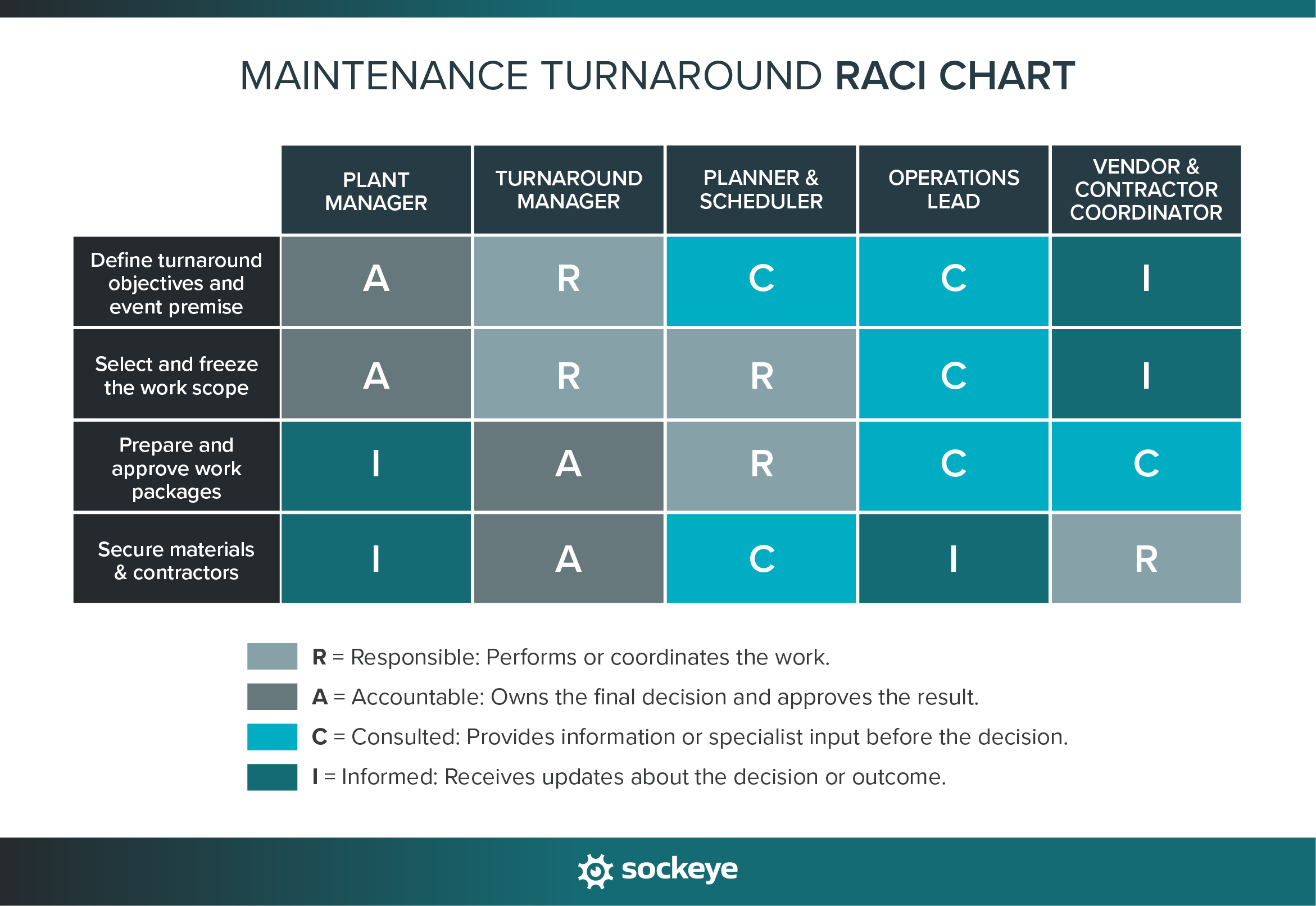
One possible approach is to use a responsibility assignment matrix, such as a RACI chart, to show who is responsible, accountable, consulted, and informed for each major deliverable.
2. Build the worklist around risk and operational necessity
A turnaround worklist should include jobs that are necessary and genuinely require planned downtime. Adding every deferred or open work order increases labor demand, creates scheduling conflicts, and extends the period when equipment cannot produce.
Risk-based work selection gives you a consistent method for deciding what belongs in the turnaround. Becht describes risk-based work selection as a process that screens individual worklist items according to their health, safety, environmental, reliability, and financial justification.
Start by collecting candidate work from sources such as inspection findings, condition-monitoring results, preventive maintenance plans, equipment history, regulatory requirements, engineering projects, and operator observations. Maintenance, operations, reliability, engineering, and safety representatives should then review the proposed work together.
Assess each listed job using standard criteria for maintenance prioritization — such as safety and environmental risks, regulatory requirements, equipment criticality, and operational impact — then combine those with:
- Probability of failure: What do inspection data, condition readings, failure history, and engineering assessments indicate about the likelihood of failure before the next maintenance opportunity?
- Need for shutdown access: Can the work be performed safely while the equipment is operating, or during a shorter planned maintenance window?
- Deferral options: Can temporary controls, monitoring, reduced operating limits, or another maintenance strategy manage the risk until the next opportunity?
- Benefit relative to effort: For discretionary work, does the expected reliability or production benefit justify the required labor, materials, cost, and additional downtime?
A simple risk matrix can help the team compare probability × consequence using agreed rating scales. However, the score should support engineering and operational judgment (rather than replace it).
Assign each proposed job one of three outcomes:
- Include: The work is required, sufficiently defined, and best completed during the turnaround.
- Complete outside the turnaround: The work is valuable but can be performed safely before or after the shutdown.
- Defer or reject: The risk is acceptable until a later opportunity, the justification is weak, or the work does not support the turnaround objectives.
TIP: Document the decision, the risk of deferral, and the person who approved it. This record prevents the same rejected requests from repeatedly returning to the worklist and gives the team evidence for future scope reviews.
3. Freeze the scope and establish a formal change-control process
A scope freeze is the point at which your team formally approves and locks the turnaround worklist. After that date, new work should enter the scope only when a documented review shows that completing it during the shutdown is necessary.
Set the freeze date early enough to complete detailed planning, procurement, and scheduling before execution begins. The appropriate date depends on the event’s size and complexity. IDCON recommends a cutoff of at least two months for an annual shutdown or turnaround.
When turnaround capacity is fixed, approving one late addition may require removing or deferring lower-priority work. This “one in, one out” approach helps prevent the approved workload from growing too large.
Record every accepted and rejected request in a change log. Update the worklist, budget, labor plan, and baseline schedule when a change is approved so that all teams continue working from the same scope.
4. Create complete work packages
An execution-ready work package gives technicians and contractors everything they need to complete a turnaround job safely and efficiently. A work order may identify the asset and requested repair, but the work package explains how the job will be performed and which conditions must be met before it can start.
Incomplete work packages create delays during the most expensive stage of the turnaround. Crews may arrive at the asset only to discover that a permit is missing, a special tool is unavailable, or operations have not prepared the equipment for maintenance.
Ideally, each work package should cover the following information:
| Work-package element | Information to include |
|---|---|
| Job scope | Clear description of the defect, required work, and expected result. |
| Task sequence | Individual work steps in the order they should be completed. |
| Asset and location | Equipment identifier, physical location, and specific component affected. |
| Labor requirements | Required trades, qualifications, crew size, and estimated labor hours. |
| Task duration | Expected clock time based on crew size, access, handoffs, and task dependencies. |
| Parts and materials | Replacement parts, consumables, quantities, availability status, and staging location. |
| Tools and equipment | Standard tools, specialist equipment, lifting devices, scaffolding, and rental equipment. |
| Safety requirements | Required permits, isolations, lockout/tagout steps, PPE, hazards, and safe work procedures. |
| Technical information | Drawings, procedures, equipment manuals, tolerances, specifications, and revision numbers. |
| Coordination requirements | Operations handoffs, contractor interfaces, access restrictions, and work by other trades. |
| Inspection and quality checks | Hold points, acceptance criteria, required testing, and responsible inspector. |
| Completion requirements | Cleanup, documentation updates, equipment handback, and work-order closeout requirements. |
TIP: Labor hours and task duration should be estimated separately. For example, a job requiring three technicians for four hours represents 12 labor hours but four hours of scheduled duration. Confusing these two measures can produce incorrect labor forecasts and an unrealistic schedule.
Take pump overhaul as an example. Maintenance cannot remove the pump until operations isolate and drain it. A rigging crew may then be needed before mechanical technicians can begin the overhaul. After reassembly, the pump may require alignment, inspection, testing, and formal handback to operations. The work package must capture each dependency rather than treating the overhaul as one uninterrupted task.
5. Secure materials, contractors, and specialized resources
A job is not ready for execution if the required crew is unavailable, the replacement part is still in transit, or another team has already reserved the only crane on-site.
Start procurement as soon as the scope becomes sufficiently stable. Long-lead parts and services may need to be ordered before the final scope freeze, especially when the facility relies on custom-fabricated components, specialist inspections, or contractors with limited regional availability.
Track material readiness using specific statuses (i.e., specified – ordered – delivered – inspected – kitted – staged). The image below shows one example.
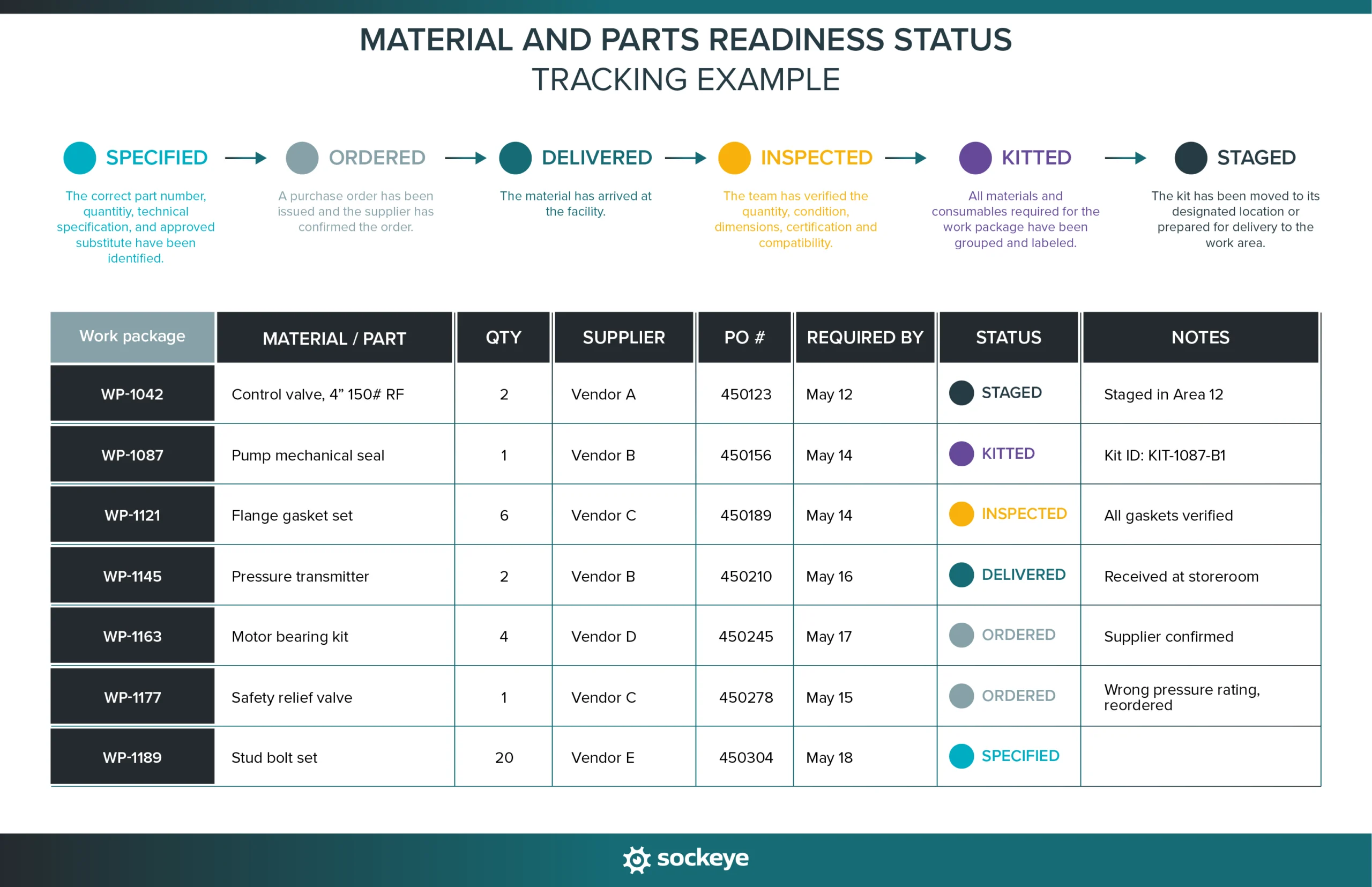
A purchase order alone does not make a job material-ready. For example, a replacement valve may arrive on time but still be unusable because it has the wrong pressure rating, flange configuration, or material certification.
Apply the same level of detail to contractor planning. Confirm:
- Trade and skill requirements: Identify the required electricians, welders, millwrights, inspectors, scaffolders, crane operators, and other specialists.
- Capacity by shift: Confirm how many qualified workers will be available on each day and shift, not just the contractor’s total headcount.
- Credentials and training: Verify licenses, certifications, site orientation, equipment qualifications, and required safety training.
- Supervision: Establish contractor reporting lines, supervisor coverage, and responsibility for progress updates.
- Mobilization requirements: Arrange site access, badging, transportation, accommodation, parking, and orientation before the event.
- Tools and equipment: Clarify whether the facility or contractor will provide specialist tools, lifting equipment, vehicles, testing instruments, and consumables.
- Scope and commercial terms: Define the work, deliverables, change-order rules, rates, overtime terms, and acceptance criteria.
For facilities covered by OSHA’s Process Safety Management standard, employers must use a contractor screening process and communicate relevant process hazards and emergency requirements. This helps ensure contractors have the necessary training and skills.
6. Plan for discovery work and other realistic contingencies
Turnaround plans should account for uncertainty because some equipment conditions cannot be fully understood until the asset is opened, cleaned, or inspected. The goal is to prepare for plausible additional work without hiding known scope or inflating every task estimate.
Becht separates turnaround uncertainty into several useful categories:
| Type of uncertainty | What it means | Example |
|---|---|---|
| Emergent work | Additional work identified after the initial scope is developed but before execution begins. | A pump fails several weeks before the turnaround and must be added to the worklist. |
| Discovery work | Additional work identified after equipment is opened or inspected during execution. | An inspection finds more extensive vessel damage than expected. |
| Estimating uncertainty | Variation in the expected cost, labor, or duration of known work. | Corroded fasteners make equipment disassembly take longer than planned. |
| Contingency | Time, budget, or capacity reserved for uncertainty that cannot be assigned to a specific known job. | Additional welding capacity reserved for possible repairs after inspection. |
Start by reviewing previous turnaround records, equipment condition data, inspection findings, failure history, and actual repair quantities. Historical information can help you estimate which assets are most likely to generate additional work and which trades, parts, or specialist services may be needed.
Planning each likely response reduces the time needed to make decisions after the equipment is opened.
Contingency planning may include reserved labor capacity, time and budget allowance, contingency materials, alternative repair plans, and approval workflow.
If such a thing does indeed happen, once approved, add work to the live schedule and update the forecast so that leadership can see how the discovery affects labor, cost, and the expected restart date.
7. Plan the restart and post-turnaround review
The turnaround plan should cover equipment restart, production ramp-up, and post-event review — not just the maintenance work completed during the shutdown.
Define the conditions that must be met before operations can accept the equipment:
- Work has been completed and approved.
- Required inspections and tests have been performed.
- Tools, scaffolding, temporary equipment, waste, and unused materials have been removed .
- Relevant maintenance checklists, SOP templates, safety guidelines, and parts lists have been updated.
- Operators have been informed about relevant changes like new hazards, operating limits, startup sequences, etc.
For facilities covered by OSHA’s Process Safety Management standard, a pre-startup safety review may be required for new or modified facilities when the modification is significant enough to change process safety information.
Closeout should also follow a defined schedule. BCG recommends reviewing turnaround performance at several points, rather than relying on a single meeting immediately after restart:
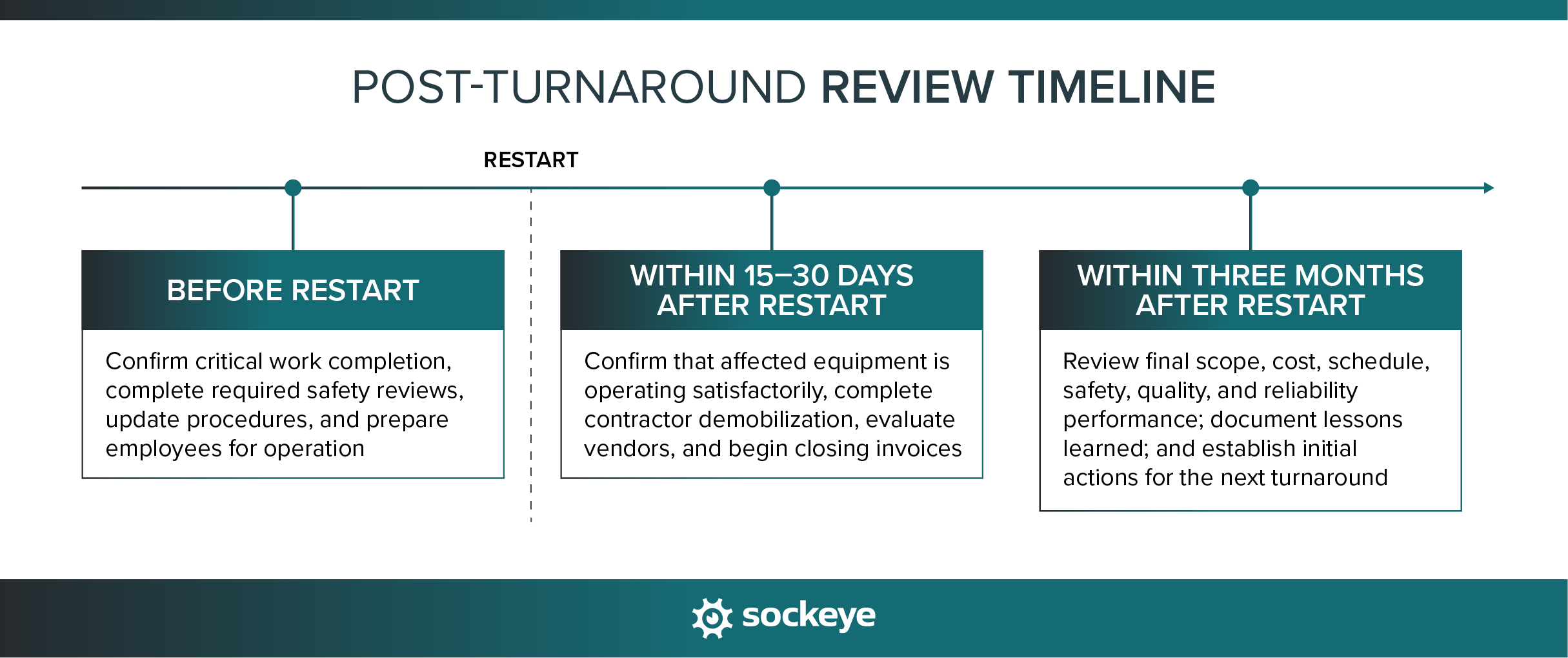
Then, the only thing left is to compare the baseline plan with actual results. Review turnaround duration, cost variance, scope growth, labor hours, overtime, schedule compliance, contractor performance, and other details after startup.
Record key lessons learned in your CMMS, project management tool, or a similar system where future planners will easily find them.
Turnaround scheduling best practices
Turnaround scheduling converts approved, execution-ready work into a coordinated plan that shows who will perform each activity and when. The schedule connects task sequences, labor availability, equipment access, contractor work, inspections, and operational handoffs to the target restart date.
A workable schedule must reflect actual constraints. If the schedule assigns the same crew to two jobs, places incompatible activities in the same work area, or assumes equipment will be released earlier than operations can provide it, the plan will begin failing as soon as execution starts.
1. Build one integrated turnaround schedule
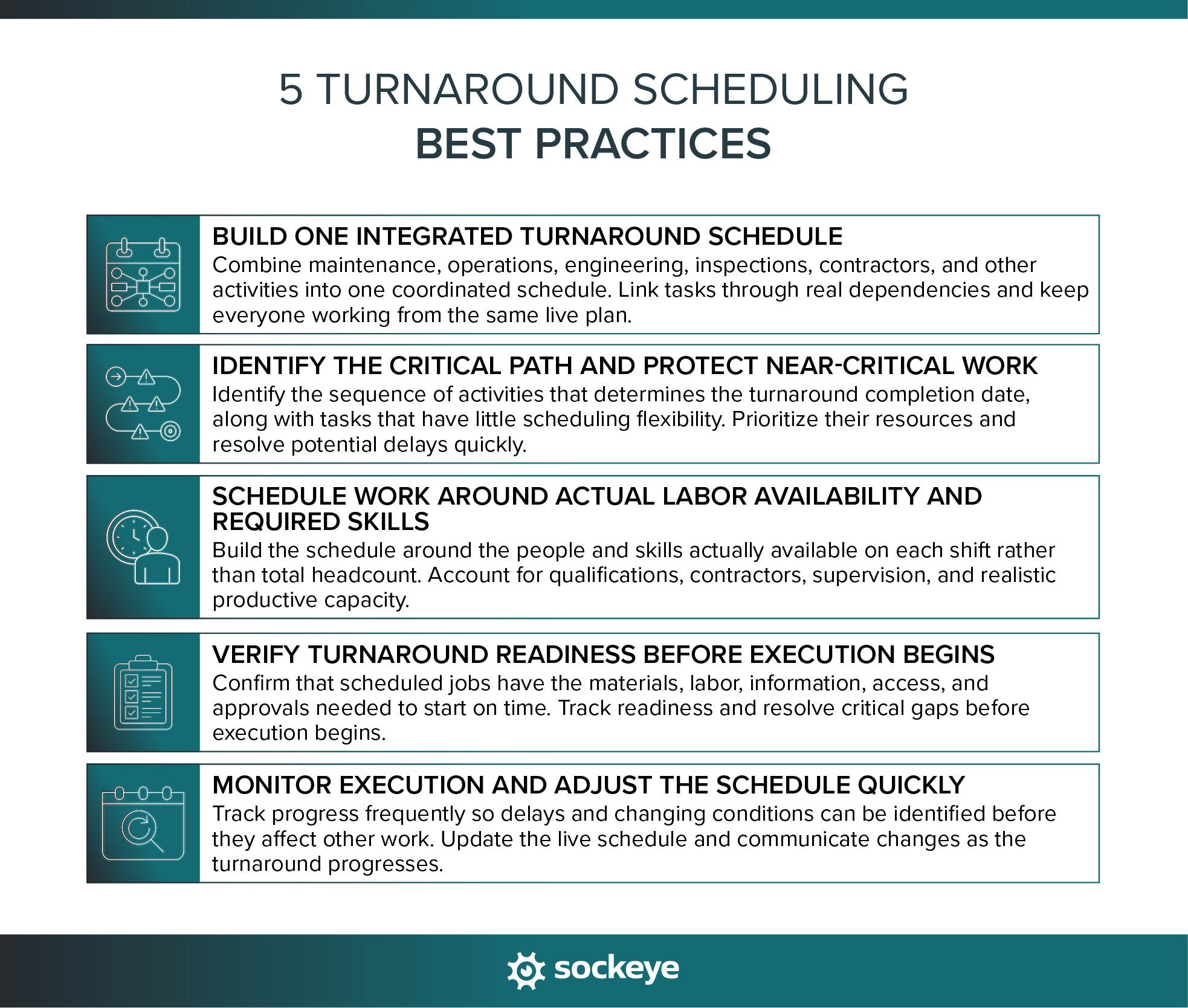
An integrated turnaround schedule combines the activities of maintenance, operations, engineering, inspection teams, capital projects, and contractors into one coordinated timeline.
If maintenance, operations, and engineering schedule work independently, they may assign incompatible activities to the same equipment or work area. Each departmental schedule can appear achievable even though the overall event is not.
Link activities through their actual dependencies. For example, technicians cannot open a vessel until operations have shut it down, isolated it, drained it, and confirmed that it is safe to access. Inspectors cannot assess internal damage until the vessel has been opened and cleaned. Repair crews cannot begin until the inspection results define the required work.
A practical schedule may contain several levels of detail:
| Schedule level | Primary purpose |
|---|---|
| Event milestones | Shows shutdown, equipment release, major work completion, testing, restart, and production targets |
| Integrated master schedule | Coordinates major activities, dependencies, critical work, shared resources, and departmental handoffs |
| Detailed work schedule | Breaks work packages into executable tasks with durations, crews, materials, and predecessors |
| Daily or shift schedule | Gives supervisors and crews a current list of assignments for the next shift or short-term execution window |
Assign one person or role to control the baseline, version history, status updates, and approved changes.
You should use a CMMS, EAM, scheduling bolt-on like Sockeye, or dedicated STO software to build the schedule. Whichever way you do it, it’s important that you can easily share the live schedule with everyone, and that rescheduling specific tasks is straightforward — ideally using drag and drop.
2. Identify the critical path and protect near-critical work
The critical path is the longest sequence of dependent activities that determines the earliest possible turnaround completion date. If a critical-path activity finishes late and the team cannot recover the lost time, the planned restart date will have to be moved.
Let’s take this simplified vessel-repair sequence as an example:
| Activity | Duration | Cannot begin until |
|---|---|---|
| Shut down and isolate the vessel | 6 hours | Production is stopped |
| Open, clean, and prepare the vessel | 8 hours | Isolation is complete |
| Complete the internal inspection | 4 hours | Cleaning is complete |
| Perform the approved repair | 12 hours | Inspection findings are available |
| Close and pressure-test the vessel | 8 hours | Repair is accepted |
| Return the vessel to service | 6 hours | Testing is complete |
The complete sequence lasts 44 hours. If these activities form the longest route to restart, they are on the critical path. A four-hour delay during cleaning could add four hours to the turnaround unless the team shortens a later activity, changes the work method, or safely performs suitable tasks in parallel.
Oftentimes, you’ll have multiple work orders done in parallel, all of which need to be completed before the next task on your critical path. Depending on the effort needed to complete them, some of those will have more wiggle room (often called available float) than others.
Activities with little to no available float should be protected by assigning qualified crews, confirming materials and permits, staging tools, resolving access conflicts ASAP, and reviewing progress more frequently.
3. Schedule work around actual labor availability and required skills
A turnaround schedule is achievable only when the right people are available on the required shift. Total headcount or total labor hours can hide shortages in specific trades, qualifications, or work areas.
Build the labor plan by day and shift. Include:
- Internal technicians: Account for normal shift patterns, scheduled leave, training, temporary assignments, and confirmed absences.
- Contractors: Confirm the number of qualified workers available by trade, day, and shift rather than relying on the contractor’s total promised headcount.
- Required skills: Match work with electricians, millwrights, welders, pipefitters, instrument technicians, inspectors, and other qualified personnel.
- Certifications and experience: Identify tasks that require specific licenses, equipment qualifications, confined-space training, or knowledge of the asset.
- Supervision and support: Include supervisors, permit issuers, safety personnel, engineers, inspectors, crane operators, and operations representatives as needed.
- Realistic productive capacity: Allow for toolbox talks, permits, travel, work-area access, shift handoffs, cleanup, and other necessary non-tool time.
Do not assume that every paid hour is available for scheduled maintenance. Use your facility’s historical data to estimate how much of each shift can realistically be assigned to planned work.
For example, ten electricians working five 10-hour shifts provide 500 gross labor hours. Usually, we recommend scheduling work up to 100% capacity to account for Parkinson’s law (The amount of work assigned will expand to fill the time available).
However, when it comes to shutdown scheduling, where the timeline is more sensitive, it is better to account for breaks, handoffs, travel, meetings, and other non-wrench time.
If we continue the example above and use an illustrative planning factor of 85% after accounting for necessary non-tool time, the schedule has approximately 425 (500 gross hours × 85%) usable electrician-hours.
Make sure to split labor demand and capacity separately for each trade — after all, pipefitters can’t do electrical work, and vice versa.
This is where scheduling tools that show live labor utilization numbers across trades are a godsend. Here’s how Sockeye does it — as you schedule work, in the upper right corner of the dashboard, you can track capacity for each craft in real-time.
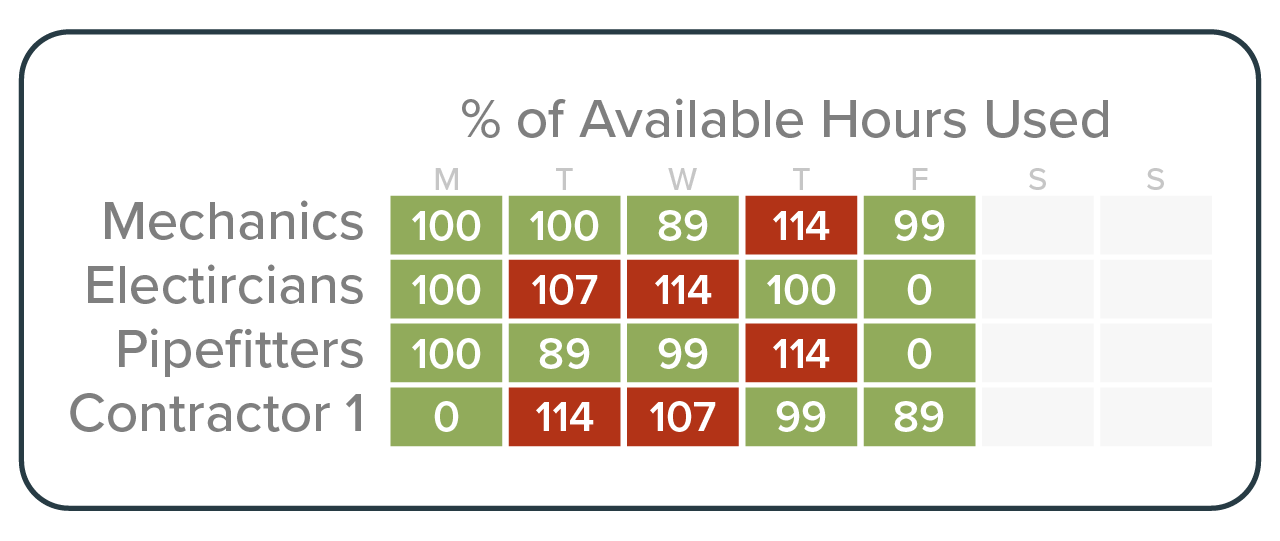
When demand exceeds capacity, you can try to:
- Resequence work: Move jobs to shifts with available qualified labor without disrupting required dependencies.
- Move work outside the turnaround: Complete suitable activities before shutdown or after restart.
- Level work between crews: Reassign tasks to another qualified team with available capacity.
- Add contractor support: Secure additional qualified workers for the affected trade or period.
- Change the work method: Adjust crew size or safely perform appropriate tasks in parallel.
- Remove lower-priority scope: Defer work when the risk is acceptable and the required capacity is unavailable.
- Revise the event plan: Extend the shutdown window when the approved scope cannot be completed safely with the available resources.
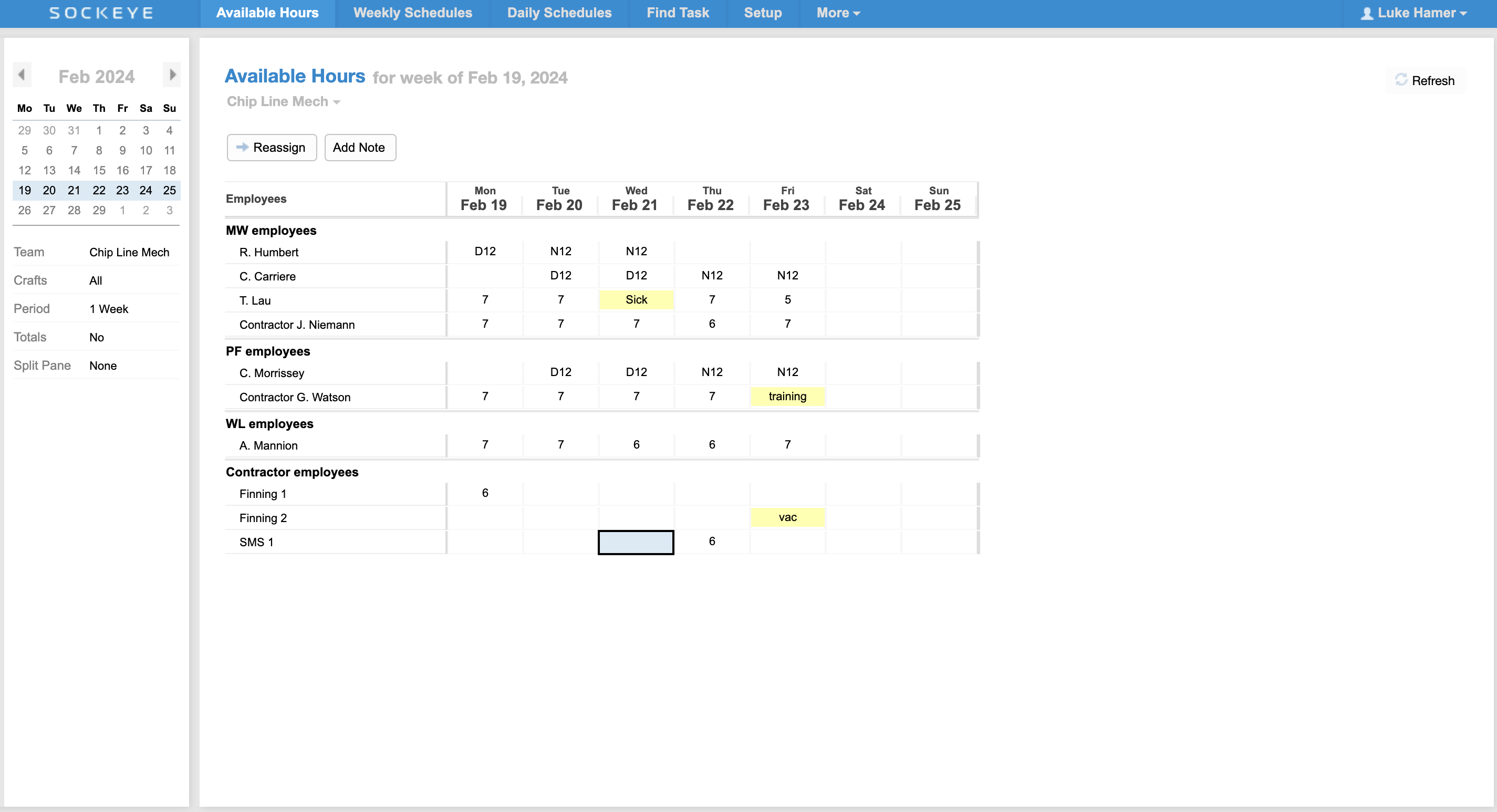
Do not forget to update labor availability before publishing the baseline schedule and throughout execution. Contractor changes, absences, extended jobs, and discovery work can quickly make the original resource plan obsolete.
Sockeye offers a simple labor availability dashboard (see below) that can be set up based on your shift patterns and then updated manually with a couple of clicks. We can also automatically sync this information from your CMMS, EAM, or HR software.
4. Verify turnaround readiness before execution begins
A completed schedule does not prove that the turnaround is ready to begin. Before execution, the team must verify that scheduled jobs have the information, materials, labor, access, and approvals required to start when planned.
Distinguish between three work statuses:
- Planned: The job scope, method, labor estimate, materials, and safety requirements have been defined
- Scheduled: The job has been assigned a start time, duration, crew, and place in the activity sequence.
- Ready to execute: All prerequisites have been verified, and the assigned crew can begin the work as scheduled
You can track work readiness by work-order count or labor hours. Labor hours usually provide a clearer picture when jobs vary significantly in size.
Work readiness (%) = (Ready-to-execute scheduled labor hours ÷ Total scheduled labor hours) × 100
For example, if 1,800 of 2,000 scheduled labor hours meet all readiness criteria, labor-hour readiness is 90%.
AP-Networks’ Turnaround Readiness Pyramid evaluates preparation and team alignment across 21 areas. Its research connects stronger readiness with more predictable cost and schedule outcomes. Your facility does not need to use that specific methodology, but readiness should be measured through a consistent, cross-functional process.
For large shutdown projects, you’ll want to record every unresolved item with an owner, due date, affected activity, and potential schedule impact. If a critical job is not ready, escalate the problem rather than leaving it hidden inside the baseline schedule.
5. Monitor execution and adjust the schedule quickly
Turnaround execution requires frequent progress updates because actual conditions will differ from the baseline plan. The scheduler must identify delays early, determine how they affect dependent work, and communicate an updated forecast before crews begin working from outdated information.
Establish a reporting cycle that matches the pace of the event. A short, round-the-clock turnaround may require updates at every shift handover, while a longer event may combine shift updates with a daily coordination meeting.
Measure progress using physical completion or defined milestones whenever possible. Hours spent do not necessarily show how much work has been completed. A crew may have used 80% of the estimated labor hours but completed only half of the required repairs.
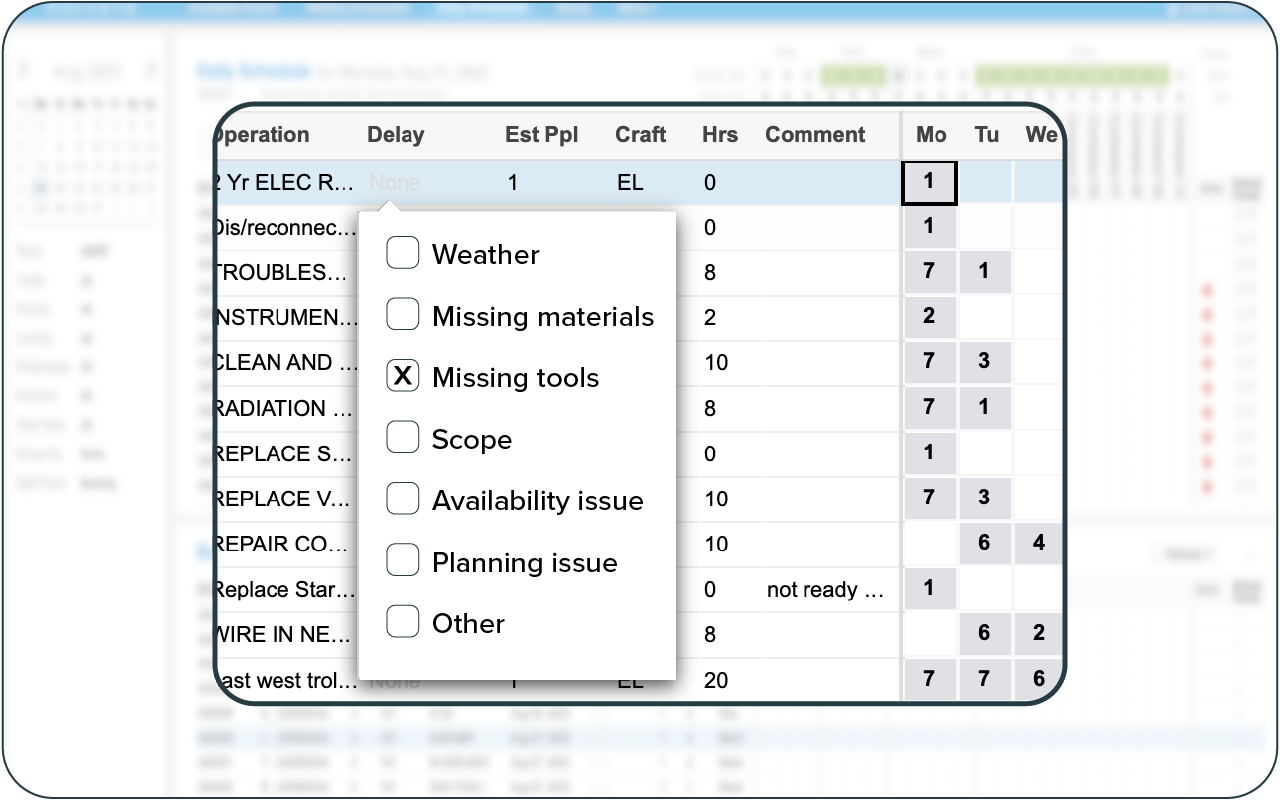
Track why activities are delayed using consistent work order delay reason codes. They help the team distinguish isolated problems from recurring planning or coordination failures. They also provide useful evidence for the post-turnaround review.
Sockeye allows you to build a configurable drop-down list. This way, for each work order that was delayed, a supervisor has an easy way to record the reason.
Last but not least, all discovery work (issues that pop up along the way) and other scope additions should be routed through the approved change-control process before updating the live schedule.
Key turnaround planning and scheduling KPIs to track
Turnaround KPIs should show whether the event is ready, whether execution is following the schedule, and whether the completed turnaround achieved its targets. Cost and final duration matter, but they tell you what happened after many opportunities to intervene have already passed.
Below is a combination of useful leading and lagging indicators you should consider tracking.
| KPI | How to calculate or track it | What it tells you |
|---|---|---|
| Scope growth | (Current approved scope – frozen scope) ÷ frozen scope × 100 | Shows how much work has been added or removed since scope freeze. |
| Work-package readiness | Ready-to-execute labor hours ÷ total planned labor hours × 100 | Shows whether planned jobs have complete instructions, labor estimates, materials, and other prerequisites. |
| Schedule compliance | Scheduled work completed within the scheduled period ÷ total scheduled work × 100 | Shows whether the schedule is realistic and being followed. |
| Labor loading or utilization | Scheduled or worked labor hours ÷ available labor hours × 100 | Identifies overloaded and underused crews, trades, or shifts. |
| Labor-hour variance | (Actual labor hours – planned labor hours) ÷ planned labor hours × 100 | Shows whether job estimates and work methods reflect actual execution. |
| Delay reasons | Number or hours of delay assigned to a specific reason code | Identifies recurring problems such as missing materials, unavailable equipment, permits, labor shortages, or access conflicts. |
| Duration variance | Actual turnaround duration – baseline turnaround duration | Shows whether the facility returned to service when planned. |
| Cost variance | Actual or forecast cost – approved budget | Shows whether labor, materials, contractors, discovery work, or schedule extensions are driving an overrun. |
| HSE performance | Track the facility’s established safety and environmental leading and lagging indicators | Shows whether work is being completed without compromising people, equipment, or the environment. |
Scope can be measured using work orders, labor hours, or cost. Labor hours or cost often provide more context than work-order counts because one added job may require two hours while another requires twenty.
Simplify maintenance turnaround scheduling with Sockeye
Sockeye helps maintenance teams turn ready-to-schedule work orders into practical weekly and daily schedules. Our scheduling bolt-on connects with your existing CMMS or EAM, giving planners a simpler way to assign work, balance labor, publish schedules, and respond to changes during a shutdown, turnaround, or outage.
Your CMMS or EAM remains the system for managing assets, tracking work history, and planning maintenance work. Sockeye adds a purpose-built scheduling and reporting interface on top of that data.
Here’s how Sockeye simplifies those annual shutdowns :
- Bring ready work into the schedule: Display approved work orders from your CMMS or EAM without recreating the same information in a separate spreadsheet.
- Schedule technicians and contractors: Assign work according to crew, required skills, shift patterns, and current labor availability.
- Keep labor availability accurate: Our labor availability dashboard can include both internal technicians and contractors. It allows automatic syncing and manual editing, ensuring your labor availability data is kept up to date.
- Balance workloads: Compare scheduled labor with available hours and identify overbooked or underused crews before the imbalance creates unnecessary overtime.
- Update assignments quickly: Move work to another technician, crew, day, or shift through a visual drag-and-drop interface.
- Share current schedules: Give supervisors and other stakeholders access to the latest published schedule instead of distributing spreadsheet copies that quickly become outdated.
- Track execution problems: Record reasons for delayed work, such as unavailable parts, equipment access, weather, or another scheduling constraint.
- Monitor scheduling KPIs: Track and report on schedule compliance, crew utilization, and other scheduling indicators.
How the AV Group reduced shutdown scheduling from 40 hours to 1 hour
The AV Group previously used spreadsheets and manual processes to schedule maintenance across six crews. Creating one shutdown schedule took Todd, their Planning and Shutdown Superintendent, up to 40 hours.
After connecting Sockeye with IBM Maximo, the company reduced shutdown scheduling time from 40 hours to just 1 hour. The integration also gave planners current work-order and labor-availability data, while visual resource leveling helped them identify imbalances between crews and reduce avoidable overtime.
Sockeye focuses on work-order scheduling, labor allocation, schedule updates, and reporting. You can use it alongside your CMMS or EAM and, for complex events, the broader project-controls tools used to manage critical-path logic, cost, engineering projects, and other turnaround activities.
Want to spend less time building and updating all types of maintenance schedules? Book a Sockeye demo to see this incredibly simple add-on in action.
