
In a maintenance department, accountability means people take ownership of their work and follow through on their responsibilities.
Many maintenance and facility managers struggle to keep their teams accountable because they lack visibility into day-to-day work. Tasks are tracked using paper or spreadsheets, updates happen verbally, and important information easily gets lost.
The good news is that accountability is not something you either have or don’t have. It can be built up over time with the right tools, habits, and leadership approach.
So let’s look at practical ways for improving accountability that you can start implementing today.
Accountability benefits both technicians and managers
“Accountability” is not a bad word. It often gets a bad reputation because people associate it with blame or punishment. In reality, good accountability creates clarity and fairness.
When maintenance work is not properly tracked, problems quickly turn into finger-pointing exercises. If a PM is missed, there is a scheduling conflict, or a machine goes down unexpectedly, rarely will someone say, “Yes, it’s my fault, I did a poor job.”
Without clear records, managers may end up assigning blame or making changes based on assumptions instead of facts.
That is frustrating for everyone — especially high-performing technicians.
Furthermore, the positive effect on the workplace environment significantly overshadows the negative stigma associated with accountability. Employees work better as a team, the accuracy of their work increases, they are more likely to help each other, and they are more invested in the work they are doing.
Just as importantly, accountability is not only for technicians.
Maintenance managers, planners, and supervisors also need to be accountable for the systems and decisions they control. That includes things like scheduling work properly, ensuring parts and tools are available, providing clear instructions, following up on issues, and supporting the team when problems arise.
As a matter of fact, accountability works only when it exists at every level of the maintenance department.
Ways to increase accountability in maintenance teams
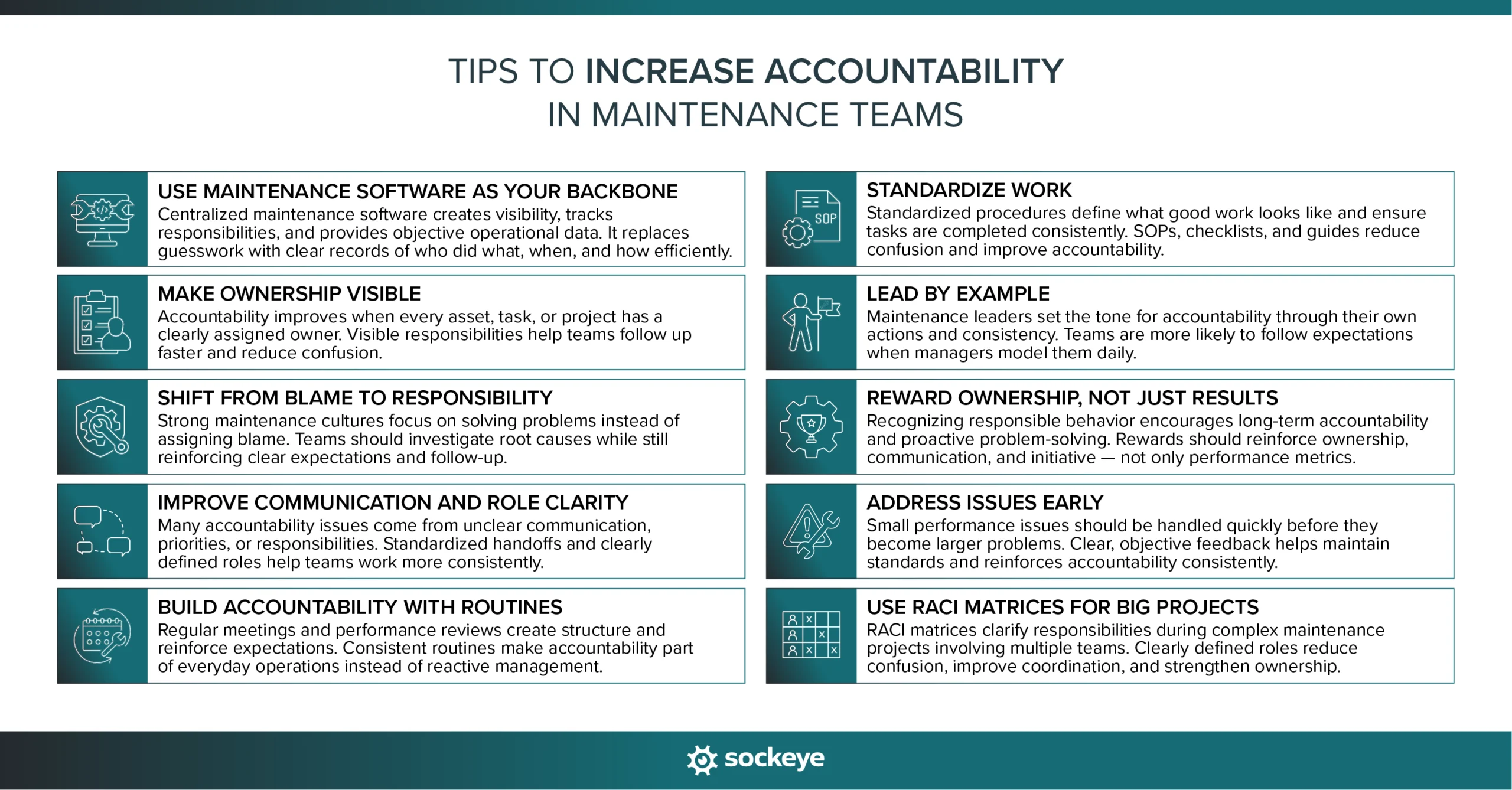
The most accountable maintenance teams usually have a few things in common: clear ownership, standardized processes, reliable tracking systems, and managers who consistently reinforce expectations.
Below are some practical ways maintenance leaders can build stronger accountability within their teams.
1) Use maintenance software as your backbone
If accountability is the goal, maintenance software — be it a CMMS, EAM, FSM, maintenance scheduling add-on, or other solution — should be the foundation supporting it.
Without a centralized system, it becomes difficult to track work accurately. Tasks may be communicated verbally, updates may get lost between shifts, and important maintenance history can disappear through overwritten spreadsheets or lost paper records.
A good maintenance platform creates visibility across the entire maintenance operation. It tracks:
- What work was performed
- Who completed it
- How long it took
- When it was completed
- Which assets were affected.
You get an audit trail for every activity. Instead of hearing “I forgot” or “nobody told me,” you can clearly see what was assigned, updated, delayed, or completed.
Additionally, with quick access to operational data like downtime, delay reasons, repairs, recurring failures, labor hours, and maintenance costs, managers have plenty of objective information they can correlate, instead of relying on assumptions, memory, or hear/say.
2) Make ownership visible
One of the biggest accountability problems in maintenance departments is unclear ownership. For example, multiple technicians will be involved in the same asset, work order, or repair process, but nobody is fully responsible for the outcome.
So, a simple way to improve accountability is to have one clear owner for each asset, task, or project.
Another thing that helps quite a bit is to make ownership visible. Many teams do this through:
- CMMS dashboards: Showing assigned work orders, overdue tasks, and technician responsibilities in real time.
- Shift boards: Displaying daily priorities, active repairs, and who is responsible for each task during the shift.
- Digital displays: Screens on the shop floor that track maintenance status, KPIs, or open work orders.
- Work order scheduling software: Allowing managers and technicians to see task progress, updates, completion status, and ownership.
- Asset ownership charts: Assigning specific technicians or teams to individual machines, production lines, or facility areas.
When ownership is visible to the entire team, responsibilities become harder to ignore and easier to follow up on.
3) Shift from blame to responsibility
When technicians fear punishment every time something goes wrong, they are more likely to hide problems, avoid speaking up, or shift blame onto someone else. That makes workflow issues unnecessarily hard to identify and fix.
Strong maintenance teams focus first on understanding: what happened, why it happened, and how to prevent it from happening again.
For example, if a preventive maintenance task was missed, the conversation should center around finding the root cause:
- Was the work order properly scheduled?
- Did the technician have the necessary parts or information?
- Was labor redirected to emergency repairs?
- Was the expectation clearly communicated?
At the same time, accountability still requires follow-up. If the same issues continue happening after expectations have been clarified and support has been provided, managers need to address the behavior directly.
The goal is to create a culture where people feel comfortable reporting problems early, while still understanding their role in resolving them properly.
Sidenote: Sockeye helps you identify root causes of delays by writing down a comment or selecting a reason from a customizable drop-down list whenever a work order gets delayed. It’s another example of how digital tools help you improve accountability and make targeted improvements.
4) Improve communication and role clarity
Many accountability problems are actually communication problems in disguise.
When technicians are unclear about priorities, responsibilities, reporting expectations, or handoff procedures, work quality becomes inconsistent.
Here’s what you can do to avoid this:
- Define roles and responsibilities clearly: Make sure technicians, planners and schedulers, supervisors, reliability engineers, and contractors all understand where their responsibilities begin and end.
- Standardize shift handoffs: Use documented handoff procedures so important equipment issues, outstanding work, and safety concerns are consistently communicated between shifts.
- Clarify maintenance priorities: Ensure teams understand which work orders, assets, or breakdowns take priority so technicians are not forced to make assumptions under pressure.
- Create clear reporting expectations: Define what information should be included in specific reports, and how often those reports should be delivered.
- Encourage open communication: Technicians should feel comfortable raising concerns, reporting issues, and asking questions without fear of blame.
5) Build accountability through consistent routines and reviews
Accountability becomes much easier when teams follow consistent routines. Regular check-ins and performance reviews keep expectations top of mind.
Consider implementing some of the following routines:
- Daily maintenance huddles: Short (10–15 minute) meetings to review priorities, equipment issues, safety concerns, parts availability, and outstanding tasks from previous shifts.
- Weekly performance reviews: Tracking planned vs. completed work, PM completion rates, delays, backlog status, labor availability and utilization, and similar metrics.
- Monthly or quarterly reviews: Deeper discussions focused on long-term trends, root causes, recurring breakdowns, and opportunities for improvement.
Over time, these routines help create a culture where responsibility becomes part of the team’s normal workflow instead of something managers only do when there is a problem.
6) Standardize work
How do you hold people accountable if guidelines are unclear?
Without standardized processes, technicians may complete the same task in different ways, and managers may struggle to define what “good work” actually looks like.
That is why standardization is such an important part of accountability.
Broadly speaking, standardization should define:
- How tasks should be completed
- What quality standards need to be met
- Which safety procedures must be followed
- What information should be documented after the work is finished.
The easiest way to start standardizing work is to identify best practices for common tasks and turn them into checklists, troubleshooting guides, and standard operating procedures (SOPs). Make those resources readily available in the field, ideally attached to relevant work orders or asset records.
To speed the process up, use our maintenance SOP template.
7) Lead by example
If you ignore CMMS updates, avoid difficult conversations, skip steps in safety procedures, or constantly miss deadlines, good luck convincing your team to do better.
“Do as I say, not as I do” attitude never works, especially when you lead large teams.
Want to create a culture of accountability? Start from the top. Reinforce expectations regularly, follow through on commitments, and demonstrate the same level of ownership you expect from the rest of the team.
8) Reward ownership, not just results
Positive reinforcement, like performance-based bonuses tied to KPIs or recognition for high performers, is great. However, rewarding outcomes alone can sometimes incentivize the wrong behaviors.
If people feel pressure to only produce good numbers, they may cut corners and hide mistakes.
That is why it is important to recognize ownership and responsible behavior, not just performance results.
As a maintenance leader, you should actively recognize things like:
- Proactive problem reporting
- Preventive actions that avoid failures
- Strong and timely communication between shifts or teams
- Thorough documentation
- Technicians who consistently follow procedures
- Employees who take initiative without being asked.
The world runs on incentives, and your maintenance department is no exception. Whether it is higher pay, additional time off, promotions, public recognition, or informal praise, reward the behaviors you want to see more of.
9) Address issues early
If repeated mistakes, delays, or careless work are tolerated, the rest of the team will take notice. Over time, standards will drop because employees see that expectations are not being enforced consistently.
Best practices include:
- Having direct, private conversations early: Small issues are much easier to correct before they turn into long-term habits or larger performance problems.
- Being specific about the gaps: Clearly explain what was missed or done incorrectly instead of relying on vague criticism and “you need to do better” statements.
- Using documented examples when possible: Refer to internal data, complaints, conversations, and observations to keep conversations objective and fact-based.
- Listening before jumping to conclusions: Sometimes accountability issues are connected to unclear instructions, missing parts, unrealistic schedules, or other operational problems.
- Setting clear expectations for improvement: Define what needs to change, when improvement is expected, and what successful follow-through looks like.
- Escalating if patterns continue: If the same issues persist despite feedback and support, stronger corrective action may be necessary.
Where there is accountability, there must also be consequences. Otherwise, team standards quickly lose credibility.
10) Use RACI matrices for big projects
Large maintenance projects often involve multiple departments, teams, and contractors. Without clearly defined responsibilities, communication gaps and confusion can quickly slow things down.
That is where a RACI matrix can help. It is a simple framework used to define who is:
- Responsible for completing the work.
- Accountable for the outcome.
- Consulted during decision-making.
- Informed about progress or updates.
For example, during a major equipment installation project:
- A maintenance supervisor may be accountable for the overall execution (that the work is scheduled on time, done properly, and finished in a given timeframe).
- Individual technicians or contractors may be responsible for installing and testing the equipment.
- Operations and Production managers may be consulted before old equipment is taken offline and new equipment is taken online.
- Production teams may simply be informed about schedules and progress updates.
It doesn’t hurt to put this on paper or in a digital dashboard. It will feel more official and improve accountability, ownership, and role clarity for everyone involved.
How the AV Group used Sockeye to create a culture of accountability
The AV Group’s accountability problem started with spreadsheet-based scheduling.
Once schedules and reports were copied into spreadsheets, anyone could make a copy of the document and change the numbers. That made it difficult to track changes, verify schedule accuracy, compare departments, or know whether teams were honestly following the system. They had KPIs, but could not trust them.
While the department relied on Maximo for other things, schedulers still relied on spreadsheets to simplify the process. They implemented the Sockeye scheduling bolt-on and integrated it with Maximo to fill in that gap.
Sockeye made the schedule visible to everyone. Planners could see which crews were overloaded, supervisors could balance work before overtime became a problem, and technicians could see their assignments ahead of time.
The results were significant. Weekly scheduling went from up to five days to under one hour. The AV Group finally had trustworthy mill-wide KPIs, better labor utilization, reduced overtime, and improved production uptime. Most importantly for accountability, Sockeye removed the ambiguity from the old spreadsheet and paper-based process. As Todd Hicks, Planning and Shutdown Superintendent at AV Group, said: “Now a work order is either done or not.”
“Sockeye eliminated the ambiguity associated with previous spreadsheets and paper-based processes. Now a work order is either done or not. We’ve captured the consistency we sought by implementing Sockeye. Having evaluated other solutions prior to deployment, Sockeye is the best work order scheduling solution on the market today!”
Todd Hicks, Planning and Shutdown Superintendent
You can read their full story here.
Maintenance accountability becomes much easier when everyone can see the same information, trust the data, and understand exactly what has been completed. Digital tools like Sockeye provide the single source of truth and keep everybody honest.
